TL;DR Quick Summary
Designing high-impact album cover art is crucial for catching listeners’ eyes on streaming platforms like Spotify. Modern design strategies focus on maximizing mobile readability with high-contrast fonts (at least 16pt), building brand recognition through signature logos or text-less single images, and leveraging high-contrast color palettes like blue and orange. Artists can also boost engagement by incorporating memorable, unconventional facial expressions, surreal graphic manipulations, or original custom digital illustrations to stand out in crowded playlists.
Table of Contents
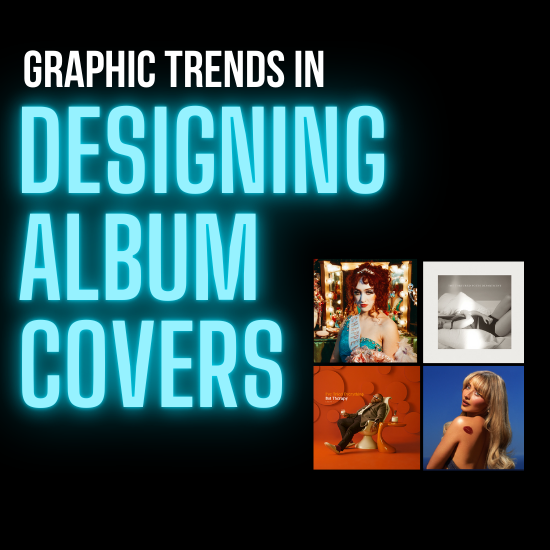
Designing album covers is one of the most important aspects of releasing your music. It is how most Spotify users judge a song before even clicking “play.” It has to capture the essence of the song while still remaining on brand. There are many trends happening now, and we wanted to share them with you.
Readable Font
Font size is one of the most important factors to consider when designing album covers. Make sure your font is at least 16pt to ensure that it is readable on a tiny screen.
If you make your name and the title of the single too small, it will be impossible for fans to see it on their smartphones. 2 out of every 10 Spotify listens happen on a phone – so you will lose the opportunity to make an impression on a potential new fan who discovers you in a playlist if they glance at the art to find the title/your name and they can’t read it.
We wrote an entire blog post all about picking out the perfect font. Click here to read it.
Another note: make sure the contrast between the background photo and your font color is high. This way, it will not get lost in the image.

Single Image Art
Another trend we have been watching closely is simple image art. They don’t have the artist’s name or title on it. We only suggest doing this if you already have a somewhat larger following, as it is an opportunity for brand awareness. Also, if you are going to go this route, stick with it. Your audience will immediately recognize a text-less album cover as yours if that is your brand. Follow it for all art to make sure your brand awareness is consistent.

Graphic Manipulation
Another trend in album cover design that has been growing over the past year or so is the use of graphically manipulated images. Much like Shawn Mendes’ self-titled album cover. Having a surreal image as eye-grabbing as Mendes’ cover immediately intrigues a listener scrolling through music. Chances are, if your cover is cool enough, they’ll click to take a listen. Get creative with it.

Signatures
This one is tried and true. Not a new trend – but one that has worked for years. Using your signature as the “Artist Name” text on your album or single cover is the perfect way to build brand awareness. People will get to know your signature (which is so uniquely yours!) and will recognize it immediately. A lot of today’s top artists have taken this route, and it works wonderfully.

Faces
One of the most studied and proven true trends is using faces in your artwork. Faces are proving to be much more memorable than landscapes as album artwork. The less unattractive, more unusual faces are more memorable than attractive. Looking at Denzel Curry’s album Taboo, the images used are so unusual they become etched in our brains. The front cover features Denzel’s face covered in face paint, while the back cover has his face covered in blood with a nonchalant face. Creating artwork with your face not only increases recognition and exposure but also helps you stand out from the crowd when doing something unexpected in the artwork.

Drawing Attention to One Object
There is another method of getting your fans’ attention and that is through drawing attention to a unique object. There is the use of complimentary colors throughout the artwork and there is the use of odd objects placed within the artwork. The colors orange and blue have the highest contrast of complimentary colors, meaning they will stand out with minimal effort as our brains can recognize it so quickly. Colors are also connected to emotions. The colors chosen can influence the listener to feel a certain way when looking at the artwork. The color scheme can also match the emotions behind the music itself.
You can also use static indoor scenes or human-scale objects to draw attention. Landscapes are forgettable, it’s the oddball that’s going to get remembered. Blondie’s Parallel Lines is a fine example of this trend as there are actual parallel lines as the background for the artwork. They also implement the color contrast trend to draw attention to a single object. Debbie Harry is not only front and center, but she is also wearing white while her bandmates are all dressed in black.

Illustrated Album Art
Perhaps the most unique trend of all lately has been illustration. There are so many graphic artists out there who are skilled in creating beautifully illustrated digital art. This will intrigue people and immediately pique their interest in listening to your song. One of our clients, Eric Selby, had his album cover illustrated by the very talented Kelley Wills. There are two kinds of illustrated art: one that is completely illustrated, and one that is an illustration atop a photograph.

Of course, your artwork is one of many steps when preparing a release. Want more? Download my music marketing check sheet.

Frequently Asked Questions
What makes album cover design stand out on streaming platforms?
Album cover design stands out on streaming platforms when it features high contrast, clear typography, and striking imagery that remains legible at thumbnail size.
What size should my cover art be?
Make it a perfectly square jpg in RGB. Three thousand by three thousand pixels is ideal and one thousand by one thousand is the floor most distributors will accept. Export at the larger size even if it feels excessive, because the same file gets used for vinyl, press and merch, and you cannot add detail back later.
Why did my cover art get rejected?
Usually for something on the artwork itself. Distributors reject art with a website address, a QR code, a social handle, prices, or a streaming service or social media logo. They also reject anything blurry, pixelated, rotated, or built from unlicensed stock photography. Check for those before you upload, because a rejection can push your release date.
Can I use the same artwork for all my singles?
Artists do it to make a run of singles read as one body of work, and visually it works. The catch is that distributors may reject duplicate album art, so identical files across releases can bounce. Keep one visual system, a shared palette, type treatment and crop, and change one element each time instead.
Do I own the artwork if someone else made it?
Not automatically. Paying a designer buys the work, but ownership depends on what the agreement says, so get it in writing that the art transfers to you and covers streaming, print, merch and ads. The same goes for photographs and stock images. Artists get caught out years later when a label or sync deal asks for proof.
Does cover art actually affect streams?
It affects whether people press play, which is the part you can control. Your cover is the size of a thumbnail on a phone, competing in a grid, so the question isn’t whether it’s beautiful, it’s whether anyone can tell what it is at that size. Shrink it on your own screen before you approve it.
Who is Ariel Hyatt?
Ariel Hyatt is the founder of Cyber PR, a music PR and marketing agency for independent artists, and the author of seven books on music marketing and publicity, including The Ultimate Guide to Music Publicity and From Buzz to Bond: How to Stop Chasing Hype and Build a Lasting Music Career. She teaches artists to build a Fan Sanctuary, an owned audience, rather than chase followers. Her books are at https://cyberprmusic.com/music-marketing-and-pr-books/
Subscribe for more!




Back to The Blog