TL;DR Quick Summary
Writing a musician bio that actually converts comes down to leading with a compelling signature story rather than a dry, chronological timeline. By avoiding common pitfalls like leading with birth dates or generic language, your bio becomes the core foundation for your entire press kit and media pitch helping you stand out to journalists, curators, and new fans.
Table of Contents
How does your current musician bio measure up?
Most musician bios fall flat because they lead with a dry, chronological list of dates and birthplaces rather than a compelling signature story. If your bio relies on generic buzzwords like “an evolution of my sound” or AI-generated phrasing, it fails to give music journalists, bloggers, and playlist curators a clear reason to care. A successful bio serves as the foundation for your entire press kit and pitch strategy focusing on your unique narrative, brand pillars, and authentic voice to stand out and build real connections with industry tastemakers and fans alike.
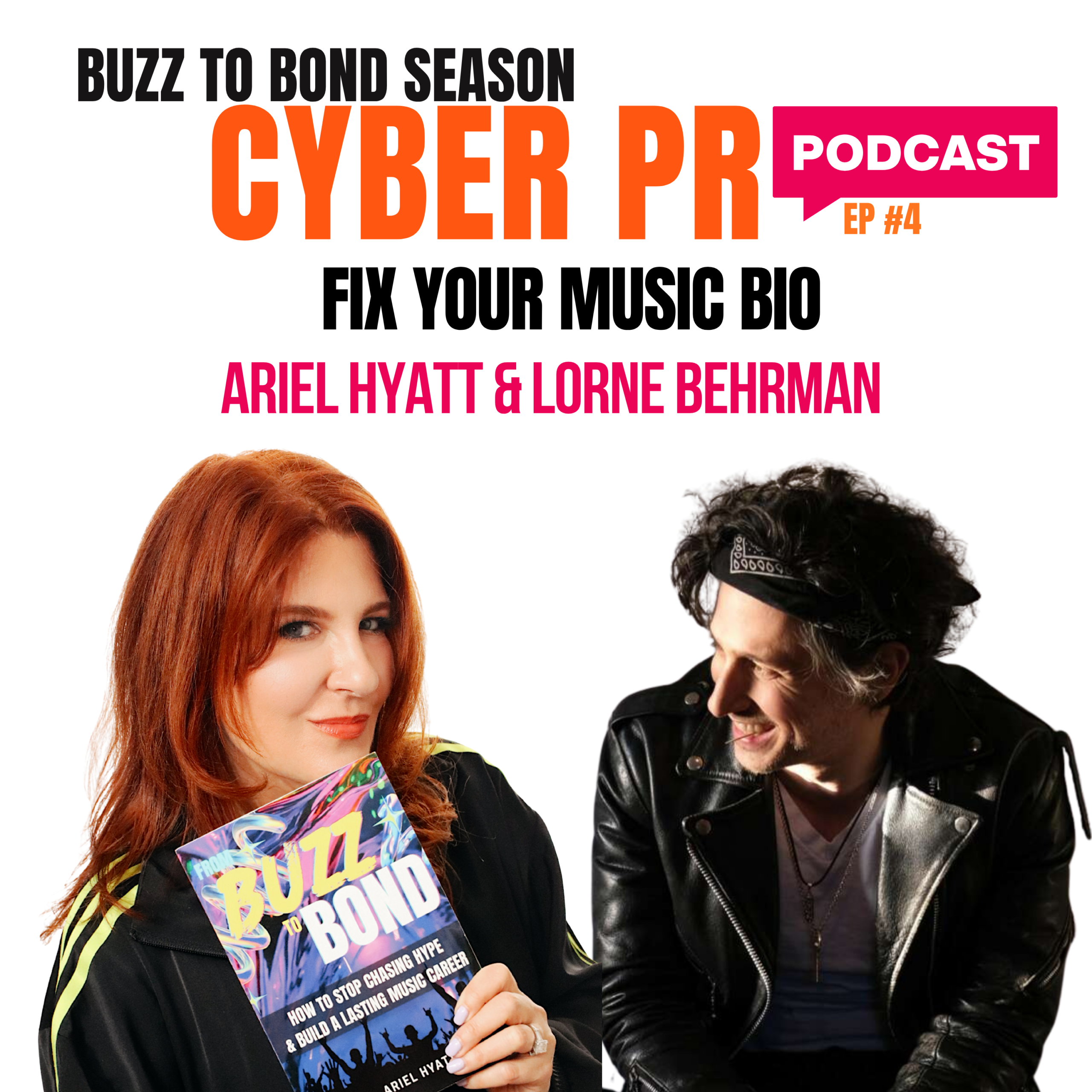
Cyber PR Music Podcast, Buzz to Bond Season, Episode 4
This is how to write the best musician bio from the industry’s #1 expert.
Writing a musician bio that actually works is one of the hardest things artists face, and almost everyone gets it wrong in exactly the same way.
If you’ve been following this season, you know I’ve been building the Bond Marketing Funnel from the ground up, starting with brand pillars, fan personas, and voice. All of it comes down to one core truth: clarity creates connection, and connection creates income.
All of it comes down to one core truth: clarity creates connection, and connection creates income.
This week, I brought in someone who has been in the Cyber PR orbit for over a decade, and who I consider the single best musician bio writer working in music today: Lorne Behrman.
Lorne’s path to musician bio writing is itself a great story. He was a punk rock teenager playing in bands, got deep into zines, studied journalism, wrote for The Village Voice and CMJ, and spent eight years as an A&R executive sitting in album marketing meetings. When a record label told him his first bio attempt was not a musician bio, he went on a mission to master the craft. His first major bio was for Joe Jackson. It set the bar. He’s since written for Julian Lennon, Lana Del Rey, and Julia Michaels, and he’s written hundreds more for me.
My artists always tell me that he was wonderful to work with and that he captured their story and saw them in ways they couldn’t even see themselves.
But the thing I admire most about Lorne is that he’s not jaded. After all these years, he still loves other musicians, and he loves to bring out their voices.
In this conversation, we get into everything: why most bios fail before the end of the first sentence, what makes a story stick, why AI bios are instantly identifiable, and how your age might be your biggest hidden advantage.
Listen to Episode 4 here → Apple Podcasts | Spotify | YouTube
The One Thing Most Artists Get Wrong From the Start
Lorne has a clear diagnosis for why most musician bios fall flat: artists lead with chronology instead of story.
“I was born in New Jersey, and I started playing piano at age three.” he sees this constantly, and it’s the kiss of death.
So is “this new album is an evolution of my sound,” which tells a listener absolutely nothing about why they should care.
A musician’s bio is not a résumé. It’s not your life story in order. It’s the answer to one question: what is your signature story? The piece of you that, when a writer, blogger, or playlist curator reads it, makes them stop and lean in.
The bio starts before the “bio.” It starts with knowing who you are, your brand pillars, your fan personas, and your voice. That’s Step 1 of the Bond Marketing Funnel, and it’s what we explored in Episodes 1 through 3. The musician bio is where that internal work gets articulated for the outside world.
Want the full mechanics of what makes a musician bio work? Read our complete guide: Five Steps to a Kick-Ass Artist Bio →
Why Your Musician Bio, Your Pitch, and Your Press Kit Are All the Same Document
Here’s something most artists don’t realize: the bio, the pitch, and the press kit are not three separate writing projects. They are the same story, told at different lengths for different audiences.
Your musician bio is the long-form expression of your signature story. Your pitch is the distillation of that story into the exact language a music journalist, blogger, or playlist curator needs to understand you immediately — in two or three sentences. And your press kit is where both of those live together, alongside your photos, links, and everything a writer needs to say yes.
If your bio lacks a clear signature story, your pitch will end up vague. And in the music business, a vague pitch is an ignored pitch.
This is why I wanted to link this episode directly to three posts that form a natural pipeline:
- Five Steps to a Kick-Ass Artist Bio — excavate the story
- Creating the Perfect Pitch — weaponize it for outreach
- Protecting Your Online Brand by Posting Your Perfect Press Kit — house it all in one place that works for you 24/7
The bio is where you find the story. The pitch is where you use it. The press kit is where it lives permanently. All three require the same raw material: an honest, specific, human answer to the question — who are you, and why does your music exist?
Why AI Can’t Write Your Bio (Even If It Tries)
We talked about the elephant in every room right now: can’t you just use ChatGPT?
Lorne’s answer is unambiguous. You can spot an AI bio immediately. The sentence structures are too even. The tone is flat. And most importantly, AI synthesizes what’s already out there — which means your AI bio will sound like everyone else’s AI bio.
The magic in a great bio comes from what isn’t already publicly available. It comes from the aside that slips out during a phone call. The thing you said while walking the dog and texted in at 11pm. The detail that surprises even you when you say it out loud.
Lorne describes his process as approaching bio interviews with zero preconceptions. He’ll spend two to three hours immersed in an artist’s music, lyrics, and videos — but he never goes in thinking he already knows the story. Because the moment you think you know, you stop listening for the real thing.
“It’s almost like drilling for oil. You have to just keep asking, keep pushing gently, until you hit that one spot — and then you go there.”
The Photographer Analogy: Why Great Bios Take Time
One of my favorite moments in this conversation was when Lorne described musician bio writing as photography.
Most of the time, he said, he’s just keeping shooting. Asking questions from many angles. Letting the artist talk around the edges of the real story until it reveals itself in a corner they didn’t expect.
Often, the subject thinks the picture is one thing, but the actual story is somewhere else in the frame entirely.
This is why bios that artists write themselves almost always underperform. It’s not a talent problem. It’s a proximity problem. You’re too close to your own story to see which part of it is the compelling part.
His advice for artists who can’t yet afford to work with a professional bio writer: interview yourself. Literally record yourself speaking. Listen back to how you talk about your music, your influences, your journey — not how you write about it. Notice the words you choose when you’re not self-editing. Study the bios and stories of artists you admire and ask why those narratives resonate. Don’t be afraid to look uncool by asking nerdy, obvious questions. The good stuff almost always lives there.
Age Is Not a Liability — It’s an Asset
There’s a pervasive fear in the music industry about age. The old industry said the window closed at 27. Artists — especially women — feel pressure to hide how old they are, to present as younger, to avoid leaning into a life fully lived.
Lorne pushes back on this hard, and so do I.
People over 30 buy music. They go to shows. They become real fans who support artists over time. When Lorne works with a woman in her 50s who’s releasing her first record, he doesn’t work around her age — he puts it in the bio, because that story connects to all the other women in their 50s who see themselves in her and think: this is still possible for me.
“I’m 51. I see someone getting started on their career, and they’re 50 — I’m like, this is cool. It’s the opposite of what they think.”
Your story is your asset. Your age is part of your story. Don’t hide the thing that makes people feel seen.
The Biggest Musician Bio Mistakes (And How to Fix Them)
Here’s a quick summary of what Lorne identifies as the most common bio failures — and what to do instead:
Mistake 1: Starting with where you were born and when you started playing. Fix: Start with the moment that changed everything. The story before the story.
Mistake 2: Saying “this album is an evolution of my sound.” Fix: Tell us what you were going through when you made it. Emotion is the bridge.
Mistake 3: Running away from your genre or your influences. Fix: Lean in. Genre signals trust. Influences create community. Someone who hates Lou Reed is not going to love you anyway — stop trying to reach them.
Mistake 4: Playing it safe with “vanilla” language. Fix: Be authentic. If you’re authentic, you don’t have to remember anything. Lorne’s rule: be who you are on the page, consistently, every time.
Mistake 5: Thinking your bio is a one-time document. Fix: A well-written bio is a gift that keeps giving. Pull from it for press releases, pitch emails, social captions, EPK copy. It’s the source document for your entire story — and it belongs in your press kit where press, blogs, and industry can find it without having to ask.
Want Lorne to write your musician bio for you?
Lorne has written signature stories for Julian Lennon, Lana Del Rey, Joe Jackson, and hundreds of independent artists, with a zero rejection rate.
If you are ready to stop wrestling with your own story and hand it to a pro, we would love to introduce you.
From Bio to Press: The Full Pipeline
Once your musician bio and pitch are dialed in, the next step is knowing how to actually get them in front of people who can help your career. That means understanding music PR — not just what it is, but how it works for independent artists in 2025 and beyond.
The landscape has shifted dramatically. Traditional print media has shrunk. But opportunities in blogs, podcasts, playlists, and niche digital press are very much alive — if you go in with the right story and the right pitch.
Read:How to Find, Research and Hire a Music Publicist →
And once you’re ready to release, here’s how to build the full promotional engine around your music — including the content strategy that gets people to the music in the first place:
Read: How to Release Music in 2026: A Realistic Guide →

How This Connects to the Bond Marketing Funnel
We’re still at the top of the funnel — Step 1: Brand Pillars, Fan Personas, and Voice.
Your musician bio is where your voice gets articulated for the outside world. It’s the public-facing expression of all the internal clarity work we explored in Episodes 1 through 3. And here’s the throughline: without a clear voice, you cannot write a compelling bio. Without a compelling bio, you cannot craft a pitch that lands. Without a pitch that lands, you’re invisible to the writers, bloggers, and tastemakers who could become the bridges to your next real fans.
The whole system is connected.
And that’s exactly why this season of the podcast exists — to show you how each piece fits, in order, so you’re not guessing.
Ready to Go Deeper?
The Bond Marketing Funnel is the backbone of my 7-Week Mastermind — a live, guided program where we work through every layer of this together: your brand pillars, your fan personas, your voice, your bio, your pitch strategy, and your full content ecosystem.
The next cohort launches July 13. We’re keeping it intentionally small — around 25 artists — so every person gets real attention and real results.
Start with the free Buzz to Bond Webinar → It’s the fastest way to understand whether the Mastermind is right for you.
Or go straight to the Mastermind →
Less buzz. More bond.
Related Reading
- Five Steps to a Kick-Ass Artist Bio — the full musician bio-writing framework
- Creating the Perfect Pitch — turn your bio story into pitches that get opened
- Protecting Your Online Brand by Posting Your Perfect Press Kit — house your story where the press can find it
- 7 Things to Know About Music PR in 2026 — the current landscape for indie artist publicity
- How to Release Music in 2026 — the full promotional engine around your releases
- From Buzz to Bond — the book — the full framework behind this podcast season
Ariel Hyatt is the founder of Cyber PR Music and the author of 7 books on music marketing. The Cyber PR Music Podcast is available on Apple Podcasts, Spotify, and YouTube.
Ready to write your bio? Download the 12 perfect Qs to ask yourself before you dive in!
[ + ] Click Here to Read the Full Episode Transcript
Cyber PR Music Podcast Season 3 Episode 4: How to Craft an Artist’s Story — The Art of the Perfect Bio for Musicians
Guest: Lorne Behrman
Ariel Hyatt: I’m Ariel Hyatt, and this is the Cyber PR Music Podcast, dispatches for the new music business. This show is all about helping independent artists stop chasing buzz and start building bonds. Real fan relationships that lead to income and long-term, fulfilling careers.
Today we’re talking about the top of the Bond Marketing Funnel: brand pillars, fan personas, and voice. This is Lorne Behrman. He’s been my friend for twenty years, and he’s been working with Cyber PR for over a decade. He is the most extraordinary bio writer. Welcome.
I’m really excited to have you here because voice is key, and in my mind, the foundational work every artist needs to do is create a bio. But I think artists go at it the wrong way. And the reason we love working with you is that you’ve never had a single bio rejected. Not the whole thing, not even two or three sentences of it. I’d love to hear a little about your background.
Lorne Behrman: Playing guitar was the big thing for me. Playing in rock and roll bands as a teenager. Parallel to that, I was really into poetry and reading, the arts in general. I got into the punk rock movement right before Green Day and Rancid. Zines were a big thing at the time, and I was a pretty terrible writer.
I remember in college my teacher said I should go back and revisit remedial grammar. So I went home, took out my sixth-grade grammar book, and revisited it. I just didn’t have the mind for it as a kid. As my music career got bigger, being in bands that toured and recorded records, I started writing for zines, and those two lanes coexisted. I was on the Warped Tour writing album reviews for Guitar World.
I’d gone to journalism school and become a pretty good writer. I wrote a cover story for The Village Voice and became a fairly in-demand writer through the nineties and two-thousands. A label asked me to write an artist bio. I wrote what I thought was great, and the label said, “This isn’t a bio.” I thought, how can this not be one? It seems like the simplest thing. You write about yourself.
I started working at record labels, was an A&R guy for eight years, sat in tons of marketing meetings, saw how people actually market albums. Then I had a baby, and someone suggested I augment my income with writing. So I started writing bios. One of the first people was Joe Jackson. I hit the bar with that one, and it’s been going ever since.
Finding the Signature Story
Ariel: When you think about crafting a bio, what is the signature story? How do you pull that out of an artist who wants to tell you where they were born and what age they started playing piano, when they think a bio is their whole history?
Lorne: Sometimes I ask the artist directly what they think the story is, because people already have conceptions. Sometimes people are brunettes and want to be presented as blondes. But in that conversation, there will be an aside that comes up, and that’s the story. You think here is the picture, but in the corner is the real one. Often I’ll stop them mid-sentence. How do you feel about that?
It’s like being a photographer getting a bunch of angles on someone. I keep shooting, keep asking questions. I study someone’s assets, spend hours listening to their music and lyrics, but I never go in thinking I already know the story. It usually catches them, and me, off guard in the moment.
A lot of it is about creating a safe space. It’s like therapy, or working with a good producer. Someone needs to feel it’s safe to talk about this, that I’m not going to use it against them. It’s an art: the art of the interview, the art of making people comfortable, and helping them accept certain things about themselves.
Ariel: You just said something really important, and I think it’s part of why you’re such an artful bio writer. You think of it like being in the studio with a producer, as someone who’s been a musician and an A&R person, who’s seen what it takes when you’re rolling out music. How does that inform how you draw an artist’s story out?
Lorne: They talk about “red light syndrome” in the studio, where a band that’s doing great in rehearsal chokes up the second the tape starts rolling. I’ve had that as a musician myself. Being a musician helps me understand the songwriting process, the struggle. You want to be presented a certain way, but a lot of times you don’t have a great voice for it yourself. Musicians are fragile people. We have egos and facades.
The listener wants none of that. Cool is not connection. Warmth is what people actually want. So the job is dismantling that facade without making someone feel naked. It’s a real balancing act. Being a musician helps. Being a sensitive person helps. But you also can’t be precious about it. You have to sell this. I understand what works.
Ariel: The music an artist makes may not line up with who they are as people, or their actual story. How do you bridge that gap?
Lorne: Sometimes the easiest move is to ask a dumb question. There’s this strange difference between your personal life and the music you make, what is that for you? I’m never afraid to ask the seemingly obvious question. The real thing I’m listening for is whether someone’s a talker. If they are, you can say almost anything and they’ll run with it.
Really, I’m listening for the disconnect. Maybe someone wants to create a persona. Then why? What is that persona, and how do they feel stepping into it on stage? Those answers become the connectors in the bio.
Drawing Out Introverted or Guarded Artists
Ariel: How do you draw someone out who’s introverted, or very guarded?
Lorne: There’s no short answer. The one thing I’d say is: do your homework. I have twenty questions for every artist, and they’re never the same set. I keep pushing, gently. Why do you think that? What are your thoughts on this? Just ask obvious questions. Sometimes you ask ten questions and find the one. Once you find the one that opens someone up, you go down that road, and you have to move fast. I’m furiously typing, asking the next question and the next.
It’s like drilling for oil. You hit that one spot and you know it. I’ll always end an interview saying I think I have everything I need. But if you’re in the shower, or walking, and something comes to you, send me an email or a voice memo. And those artists will send me a huge paragraph out of nowhere: “I was walking the dog and I thought of this.” That’s it. That’s the line.
Ariel: It’s amazing, it’s almost like an after-the-fact discovery.
Lorne: Right. Some people are slow to warm up. The call ends, and then they have all these ideas. Maybe they’re not a talker on the phone, but something got sparked, and they’ll follow up by email. “I was thinking about this,” and it’s a beautifully articulate line. I just pop it right in.
Why Bios Matter More Than Ever
Ariel: Why are bios important right now, in this age of social media and everything moving so fast?
Lorne: Stories are an evergreen medium for connection. We love documentaries, biopics, anything with a real story. I’ve written hundreds of these and no two are alike. A million songs drop on Spotify every week. How do you stand out? How do you connect? Through a personal story. Your songs may be great, but that’s not enough on its own. You’re essentially saying, “help me, please listen to me,” and the way you do that is with a story. The human touch and connection always cut through.
The bio process is also clarifying for the artist. A lot of artists genuinely aren’t sure what they do. You sit with them and figure out who they are, and that’s useful for them too. In the glut, bios matter more than ever, because that’s how you get seen and heard. Stories connect us.
Why AI Can’t Replace This
Ariel: There are so many tracks being uploaded to Spotify every week now, and a lot of that is AI. Are you worried that in a world where anyone can open ChatGPT and say “write me a bio,” you’ll be out of a job?
Lorne: No, and here’s why: it’s the humanness. You can spot an AI bio immediately. It can’t actually determine what someone’s real story is, because that’s not always what the artist thinks it is either. It’s often an aside, something that comes up sideways, like I mentioned before. People misunderstand what a bio even is. They think it’s “I started studying piano at this age,” a straight timeline. That’s not a bio. That’s what an AI bio sounds like: very linear.
What matters is what’s foundational, when you picked up the piano or got your first MPC, what actually shaped your artistry. Was it a summer camp, watching someone play guitar? AI doesn’t have that nuance. And the interview itself, one person talking to another, can’t be replaced. You can’t synthesize that kind of connection. When an artist and I work together, that moment of disclosure, of them finding out who they are, is golden.
AI bios also all sound the same, because they’re a synthesis of what’s already out there. I’ve studied this. The sentence structures are unnaturally even. Something always feels slightly wrong underneath. There’s a consistency to it that’s honestly kind of boring.
Matching an Artist’s Tone
Ariel: You’ve also got a lot of copywriting experience. Do you help artists carry their story across other platforms? How do you know how to amplify it?
Lorne: I try to walk the line between amplified and ridiculous. When I craft a bio, I put in one or two pull-quote lines, usually in the second or third paragraph, sentences an artist can lift and reuse anywhere. It’s a gift that keeps giving. Figuring out someone’s tone matters too. Some people want something pared down and nonchalant. Others want it loud and colorful.
Ariel: When you craft a bio, do you start with the music or the story?
Lorne: Probably the story, honestly, because the music is already out there. The story is the untold part.
Young Artists vs. Artists Starting Later in Life
Ariel: There are two ends of the spectrum we work with a lot at Cyber PR. Young artists who haven’t done much yet, and older artists, especially women, who are sometimes fearful of revealing their age because everything feels so youth-obsessed. How do you approach both?
Lorne: With younger artists who don’t have a lot of career history, I want to know what music meant to them when they were young. Sometimes it was an escape. Maybe they were bullied, and music gave them a sense of safety and strength.
With someone older, and a lot of people past thirty think they can’t admit that, the truth is people live well past thirty, and people over thirty are the ones actually buying records and going to shows. You’re missing out by hiding who you are from your own audience. Youth gets commodified, but a career isn’t over at a certain age. I love working with a woman in her fifties who’s just starting out, because there are so many other women in their fifties who want to be songwriters too. This is an era of women over fifty completely rewriting that narrative.
Don’t worry about the young kids who might not get it, that’s fine, there are plenty of people who will. With older artists, it’s about telling them it’s okay to be exactly the age they are, and that it actually works in their favor. I try to put their age right in the bio, because it connects. I’m fifty-one. When I see someone starting out at fifty, I think, this is cool, we’re the same age. It’s the opposite of what people assume. The old music business said you were done after twenty-seven. We’re past that. We make the shots now, the artists and the media people. You can have a hit in your fifties. You can have a whole second act. You’re leaving money on the table if you ignore that.
Ariel: So it’s about leaning into the niche, leaning into the real story.
Lorne: Exactly. It’s all about connection, and there are people at every age who will connect with your story.
The Biggest Bio Mistakes
Ariel: What are the biggest mistakes you see in bad bio writing?
Lorne: “I was born in New Jersey and started playing piano.” We’ve all seen that opener, and it’s boring. Also: “This new album is an evolution of my sound.” That doesn’t make anyone want to buy the album or hit play.
Artists who are hesitant to admit they’re part of a genre is another big one. Nobody responds well to that. As an artist myself, I hate when people act embarrassed by their influences. Embrace them. Don’t run from them. Someone who claims to hate Lou Reed probably isn’t going to connect with people who love Lou Reed either.
Ariel: I bet this comes up a lot: fear about doubling down on a brand, or an opinion, especially in a divisive world right now. How do you coax people out of playing it too safe?
Lorne: Embrace it. It’s a balance, especially with something like Americana, which can lean right or left depending on the artist, because the genre itself both celebrates and critiques America. I try to be as authentic to the artist as they are. If they’re openly anti-Trump, I’ll ask: do you want to go out like this? Totally fine either way. Or do you want me to pull it back a little? I love when an artist just says, this is who I am. If you’re authentic, you don’t have to remember any artifice. It’s so much easier. You’re not managing a carefully constructed thing. I focus on what comes out naturally, what they’re actually talking about and how they talk about it. Quotes are a great way to find that midpoint.
Research and Prep
Ariel: How do you prepare for an interview? Visual research, listening to the music, scouring the internet?
Lorne: I spend two or three hours with everything before I even get someone on the phone. I read every asset they send me, look them up online, look at photos, go through the lyrics. I spend a couple of hours just absorbing it, without writing any questions yet, because I don’t want to walk in with a fixed idea of who they are. That never works.
That’s when you start noticing the disconnects. Someone sings like this, but is also kind of a nerd, which is great. That’s an awesome thing to lean into. I try to go in with zero preconceptions, but I’ll have questions ready. Why this style of music? You’re a city person, why country? Or you’re a country person, how’d you end up in heavy metal? I’m listening for patterns in how someone speaks. If I can find them on a podcast appearance anywhere, I’ll listen to that too. How do they talk? What do they think of themselves? I’ll watch old videos. Everything.
A Favorite Bio Moment
Ariel: You’ve written hundreds, maybe thousands of bios. Any moments that stand out?
Lorne: Julian Lennon told me it was the best bio he’d ever had. That was amazing. For me, the moments I love most are the women who think they don’t have a voice anymore, that excites me every time. I remember an artist who’d been a newscaster, in her fifties, doing her first record. I was just so excited that she was excited. That energy isn’t reserved for the young.
Big names are great, they bring in business, sure. But it’s really the people who say, I’m going to do this, I just got divorced, I lost my job, I got a severance package, or I just decided I’m doing it anyway. Single parents working three jobs who still found the time to make the record, and are determined to do the best job they possibly can. Those are the ones that get me.
Advice for Artists Who Can’t Afford a Bio Writer
Ariel: What’s your advice for someone who can’t afford to work with someone like you yet, but needs to start finding their own bio voice?
Lorne: This sounds strange, but interview yourself. Listen to interviews with artists you love, and pay attention to good interviewers. Don’t be afraid to embrace your influences. Don’t be afraid to be marketable. Study the people whose careers you admire. What’s their story? What’s their trajectory? Look at the stories that actually resonate with you, and start there.
Closing
Ariel: Lorne Behrman, you are one in a million. I’m so grateful we get to keep working with you, and that you keep sharing your perspective with us. I think it’s genuinely overwhelming for artists in today’s world to find the traditional, long-form signature story. Thank you for being here.
Lorne: Thank you for having me. I learn a lot from you. I’m grateful to be here.
Ariel: This isn’t about more followers or more streams. It’s about real fans who actually support you. If you want to go deeper, check out the free Buzz to Bond webinar in the show notes, or visit Cyber PR Music for over three hundred articles and strategies for today’s music business. Less buzz, more bond.
Subscribe for more!


Back to The Blog