
TL;DR Quick Summary
Cyber PR founder Ariel Hyatt interviews music marketing expert Corey Denis about social media marketing for musicians, covering which platforms deserve an artist’s time, how many to run at once, and why engagement beats reach.
Table of Contents
What are the best platforms for growing my fanbase as an indie musician?
Corey Denis is a woman I admire deeply. Corey is a woman who understands social media. She and I have an interesting history. She also worked at What Are Records? the label I started at back in the early 90’s when you could actually sell 1,000,000 albums for a band that was dropped from Arista (yup, we did!)
But she arrived after I had already left, so we never actually had the pleasure of working together during the time.
Corey is nothing short of a genius at marketing bands and artists.
She is brilliant because she thinks about both sides of the fence from both the artists and the fans perspective.
And she taught me how to tweet.
I’m thrilled that she was willing to be interviewed again for this piece. The first edition of this interview went live years ago and it is fully updated now for 2018.
Enjoy her responses, and if you love them and want to read more about how to stop wasting time on socials and start making magic click here.
Ariel Hyatt: Why is it important that artists participate in social media?
Corey Denis: In today’s consumer-driven digital environment, where experiences are personalized based on behaviors, social media is essential to the distribution of information and the consumption of art. For artists, Social Media is more than a profile with a bio and a link, it’s an extension of the authentic creative self. Once an account is created, it requires the same attention as any IRL relationship. It’s always been participatory & voluntary, but Social Media has become an essential part of an artist’s career. Although marketing is most often a choice, avoiding social media is similar to refusing a sale. The most important word in your question is participate.
According to Pew Research Center’s study, 85% of young adults in America use a smartphone. Social Media has become part of popular culture. Without fans, it’s difficult to sell art, and without social media, it’s challenging to create or grow a fanbase & communicate with them. It’s often helpful to think of social media as an authentic real-time artform which simultaneously feeds on popular culture while giving everyone the equal opportunity to create it. Learning how to participate in Social Media opens the door to a new set of tools which can enhance current projects. While Social Media can be as simple as an authentic conversation, it can also be as intricate as an oil painting.
Like art and music, form and function matter in Social Media. Each platform allows for highly visual methods of communication with a variety of styles & functions. My favorite trick for platforms with limited characters (Twitter, for example) is to think of it as Haiku. Words do matter.
Social Media participation can add new layers to art projects, and real-time revelations which fuel creativity. Many of the artists I’ve worked with have found Social Media to be a creative inspiration; reciprocally, many fans I’ve encountered find it equally as inspiring, because of the artists they follow on Social Media. It’s essential to reply to comments & stay active.
Do you think it’s important for artists to be on as many sites as possible, or be selective and only actively use a few?
It can’t hurt to have a profile on as many sites as possible, and it’s wise to create profiles if only to hold the username for later use.
However, creating profiles just for the sake of having them is ineffective. It’s important to use each profile and network, and integrate it into your process.
An artist could viably create 50 profiles and optimize their “social SEO,” but it’s crucial to consider what a potential fan will find once they get to a profile.
There are a lot of social spaces to choose from, but it’s best to keep it simple.
An artist could viably create 50 profiles and optimize their “social SEO,” but it’s crucial to consider what a potential fan will find once they get to a profile.
Start with 3-5 platforms and stay active. Don’t give up! Learn to use each tool to its maximum ability, without constantly pitching a sale.
If there’s room for more social media profiles after mastering 3-5, participate in additional platforms – one at a time. The key is to not feel overwhelmed, and have fun!
AH: Name the top 5 sites you think all artists should be active on
Instagram
Facebook
YouTube
Twitter
Spotify
But also consider these social platforms as well:
Snapchat
Kickstarter
Reddit
Periscope
Patreon
What would your recommendations be for the busy artist that only has 30 minutes a week to dedicate to social media?
I would recommend finding more time in the week. With more than 80% of the population carrying mobile phones with apps on them, there’s a chance that potential fans, show-goers, and art consumers are using social media more often than 30 minutes per week, so why shouldn’t you?
Authenticity requires knowing how the social media platform works, and practice is required.
However, if 30 minutes is the maximum amount of available time, I recommend spending that time joining conversations and replying to others.
If there’s time, be creative and take advantage of the tools on each platform.
Use a photo, a link, a video, and get comfortable with the possibilities of each platform.
Use each minute wisely, and socialize. Remember that social media conversations are similar to signing autographs after a show; dedicate time to talk to other people, even if it’s only 30 minutes a week.
What’s the best way for an artist to get shared on socials?
Try everything and fail fast. Focus on social media, and distribution to services like Spotify, YouTube, Pandora, and iTunes.
Platforms like YouTube are also social; when your art is available on a social distribution service, focus on platform participation, sharing playlists to social channels, and making sure fans know where they can find your art.
Once your art is available on a social distribution service (like YouTube), start participating.

When consulting with a band or an artist, what do you do for them that helps them sell more music online? How do you quantify your results? How can they?
Simply put, I teach all clients about social platforms and help them strategize their use of social media. Success is measured by engagement, not reach. The most realistic way to set goals is to fail fast, find the bright spots, and shine a light on what works. Social Media is social, and humans are fickle.
Don’t make predictions as to what will work without first trying just about everything. I suggest quantifying results using free analytics tools provided by platforms and set realistic goals based on the results that can only be acquired through swift and gracious failure.
Try everything, and look for growth. When there’s an increase in engagement, lean-in to what works, and set new goals based on engagement rather than impressions.
Check on your own progress twice a month.
Can you name five musicians or comedians who are doing it right online?
Finally, if I was an artist and I had $500 of promotional money to spend, what would you advise me to do?
Wait until you have something to sell, and use your money to boost any Facebook Posts connected to the item you’re selling.
This will work best for artists who focus on engagement prior to selling something to their fans.
Want to put what Corey says into action?

How to identify your ideal fan archetype… Click to get it.
Frequently Asked Questions
What are the best platforms for growing my fanbase as an indie musician?
The best platforms for growing a fanbase as an indie musician are Instagram, TikTok, and YouTube. Effective social media marketing for musicians requires posting consistent, engaging video content tailored to each app’s audience. Independent artists who focus on building a strong community on these visual platforms can drive reliable traffic to their music and merchandise.
Do I have to post video?
Mostly, yes. The platforms that reach new listeners push video hardest, and a song needs something to play over. It doesn’t have to be you dancing. A phone on a stand while you play, a lyric on screen, a rehearsal clip. Post the song doing the work rather than a photo asking people to go listen.
What’s the difference between reach and engagement?
Reach is how many people saw it. Engagement is how many did something about it. Reach is mostly decided by the platform and swings wildly. Engagement is saves, shares, comments and follows, and it’s the closest thing you have to a signal that a person cared. A small post people share beats a big one they scroll past.
Should I join every new platform that comes along?
Claim your name, then wait. Early users sometimes get a boost, but most new platforms disappear and the ones that stick take a year to matter. If your audience isn’t there yet, you’re performing for nobody. Watch where your own fans actually go, and move when they do rather than when the headlines say to.
What if I hate social media?
Pick the one that hurts least and do only that. Some artists write well and hate being on camera. Some talk easily and hate writing. Play to whichever it is, and let the rest go. An email list also works, and it’s often a better fit for people who find posting exhausting, because it’s occasional and it’s yours.
Who is Ariel Hyatt?
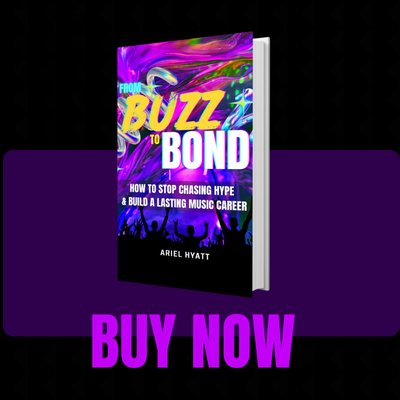
Ariel Hyatt is the founder of Cyber PR, a music PR and marketing agency for independent artists, and the author of seven books on music marketing and publicity, including The Ultimate Guide to Music Publicity and From Buzz to Bond: How to Stop Chasing Hype and Build a Lasting Music Career. She teaches artists to build a Fan Sanctuary, an owned audience, rather than chase followers. Her books are at https://cyberprmusic.com/music-marketing-and-pr-books/
Subscribe for more!

Back to The Blog