TL;DR Quick Summary
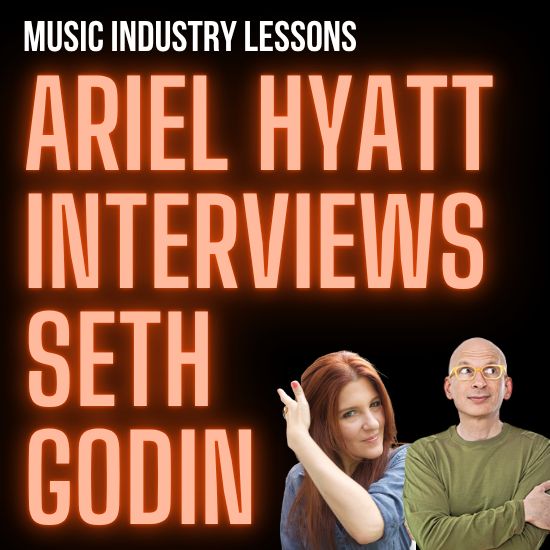
Seth Godin talks with Ariel Hyatt about music marketing, why the audience in the middle has disappeared, and what independent musicians should actually be afraid of. This article covers two conversations, the quotes Ariel still uses on stage, and the reframe that changes how artists think about giving their music away.
Table of Contents
What did Seth Godin tell Ariel Hyatt about marketing music?
Across two video conversations, Seth Godin told Ariel Hyatt that the bell curve has melted and there is no longer a middle to market to. Artists should make something for weird people, and should be far more afraid of being obscure than of disappointing someone. Marketing, in his definition, is not advertising. It is finding the best way to touch people so that they tell their friends. And the money problem most independent artists think they have is not a piracy problem. It is an obscurity problem..
Why Seth Godin is worth listening to on this ?
Seth Godin is not a music industry person, which is exactly why these conversations are useful. He is the person who named the ideas the music business has been borrowing for twenty years.
Permission marketing. The purple cow. Tribes. Those are his. He built and sold Yoyodyne to Yahoo, ran direct marketing there, founded Squidoo, has written around twenty books, and was inducted into the American Marketing Association’s Marketing Hall of Fame. His daily blog is one of the most-read in the world.
He also wrote a short post about what other industries could learn from the music business that rippled through the music industry hard enough that the rest of us were quoting it back at each other from conference stages for years.
I have spent my career on the publicity side of the problem he describes from the strategy side. When Seth and I talk, we are looking at the same artist from two different angles.
These conversations were recorded over a decade ago, as the keynote at Fuse Festival in Adelaide, Australia. I am archiving them here because almost none of it has dated. The platforms in the background have changed. What Seth says has not.
Conversation one: the bell curve is melting
The first conversation starts with his book We Are All Weird and the word “normal.”
Seth’s point is that “normal” is a statistics term, not a compliment. It describes the fat middle of a bell curve, and for most of the last century every person making music, paintings, scissors or pencils aimed at that middle, because that was where the people were.”
His argument is that the middle has been draining out to the edges for decades, and the internet accelerated it:”
“The Internet does two things. First, it lets weird people find other weird people, which amplifies their weirdness. And the second thing it does is it lets marketers, anyone who makes something they want to talk about, reach groups of people who aren’t the normal ones. Reaching the masses is too expensive now.”
I read him his own line from the book during this conversation, because it is the one that scares artists most:”
“If you persist in trying to be all things to all people, you will fail. The only alternative then is to be something important to a few people, and to get there you must disappoint some slightly engaged normal folks who can live just fine without you.”
That fear is real. The fear of declaring who you are is one of the most common things we see at Cyber PR. So I asked him how you get over it. His answer was not a pep talk:”
“You can never rationalize your way out of fear. If you’re afraid of snakes and the dark, but you have to run across a dark room to get away from some snakes, you probably will, because snakes are scarier than the dark. So the message to the musician is you should be more afraid of being obscure. You should be more afraid of being ignored. You should be more afraid of no one ever hearing you than you should be afraid of disappointing a few people.”
He follows it with a second piece of advice that most artists have never been given permission to take: stop reading reviews, and stop letting people who do not get it post on your site. “The haters are going to hate and it’s not your job to make them happy.””
Then there is the part I quote most. Musicians tell me constantly that they hate marketing. Seth does not accept the premise:
“You cannot be a musician and you cannot be an artist until you acknowledge that one of the things you’re trying to do is make a dent in the universe, that you’re trying to touch people. Otherwise just play in your garage. But if you’re trying to touch people, guess what marketing is? Marketing is finding out the best way to touch people, and to touch them in a way that resonates enough that they tell their friends.”
And on outsourcing all of it: “you just hired someone not as good as you to go tell your story.”
The rest of the conversation is about what the job actually is now. Seth’s framing is that a musician in 1970 was hired to fill a slot in a record store, and there are no slots left, because there is no retail left.
“What you do for a living is you lead a group of fans who want you to take them somewhere and who want to hang out with the other fans.”
The Grateful Dead are his model, “the Apple computer of the music industry.” The music was free. Being in the room with ten thousand other Deadheads was thirty dollars. He points at Moby and Keller Williams as smaller versions of the same thing, artists who can fill a room anywhere by emailing a list.
He closes on the price of doing any of it:
“The guy who invented the ship also invented the shipwreck. If you want to be great you have to be prepared to fail. If you want to be mediocre you can be consistently mediocre and never fail. Those are the two choices.”
More on finding the people at the edges in The Musician’s Guide to Finding A Target Market..

Conversation two: the problem is not piracy
Part two opens with the question every artist asks first, which is where to start.
He closes on the price of doing any of it:
“Everyone has 10 friends and family members, 10 fans, 10 people in the world. If you play for them and they say ‘oh, that was very nice’ and walk away, you need to change your music. If on the other hand those 10 people bring friends tomorrow, now you can amplify what you’re doing. But nobody, not even Ariel Hyatt, can change the world for you if those first 10 people don’t think you’re amazing.”
He is blunt about what happens when artists skip that step: “too many folks are spending their life savings yelling louder their boring stuff.”
I brought up the thing that had every independent artist upset at the time, which was streaming payouts and being pushed to give music away for free. He cut me off:
“You had me until your last sentence. There’s never, ever, ever been a better time to be an independent artist than right now. Ever.”
His reasoning is worth sitting with. Artists would have killed for free national radio play a generation ago and made nothing from it directly. The internet is that, without having to bribe anyone. So the question is not whether people paid for the file:
“If everyone knows your song, do you make more money or less money than if no one knows your song? If everyone knows my song, my heart will be happy, because that’s why I made the song, and my pocket will be happy, because someone’s going to show up and say come do a live gig.”
Which leads to the sentence from this interview that gets repeated more than anything else either of us said:
“The problem, as my friend Tim O’Reilly says, is not piracy. The problem is obscurity. Every single person listening to this thousands of miles from here is obscure. If you can solve the obscurity problem, you don’t have to worry about the money. It will take care of itself.”
Worth noting that Seth credits Tim O’Reilly for it, which most people quoting it do not.
Geography is an excuse. We were in Adelaide, about as far from the traditional music industry as it is possible to be, so I raised it. Seth pointed out that he was exactly as far from that room as that room was from him, and he had gotten there anyway. “We gave you a microphone. The internet’s a microphone. Here it is. It’s on. Use it.”
Your friends are the answer. Asked which entity would disrupt music licensing, he said “your friends,” then said that is the answer to any question. His blog went from twelve readers to a million not because he paid anyone, but because those twelve brought friends.
Remarkable is decided by the market, not by you. From Purple Cow: “I don’t get to decide that your music is good. The market does. If the market talks about it, it’s remarkable.” His example is Hugh MacLeod drawing cartoons on the backs of business cards and giving them away, and Prince, who made records people insisted on playing at parties because listening to Prince alone is no fun.
A website is not a platform. “A platform comes from the notion of speech giving. A website that has no readers is no platform. It is just a bit of technology.”
Nobody is coming. On waiting for a label call: “The chances that Clive Davis is going to call you up and say you’re my next one are zero. That game is over. Stop waiting for the phone.” He does not frame that as bad news. “It means that you have all the power. There isn’t some magic Santa Claus who may or may not give you a little. It’s yours.”
He ends on two words: pick yourself.
More on building the platform once you have the ten in How To Promote Music..

Key Takeaways
- The middle of the market has drained out to the edges. Make something for weird people, because reaching everyone is no longer affordable and no longer works.
- Fear does not respond to logic. Replace it with a bigger fear: being obscure. Marketing is not advertising. It is finding the best way to touch people so they tell their friends.
- The job is no longer filling a slot in a store. It is leading a group of fans who want to be around each other. The Grateful Dead built the model. Start with ten people. If they do not bring friends, the answer is not more promotion, it is better work.
- The problem is not piracy, it is obscurity. Solve obscurity and the money follows.
- A website with no readers is not a platform, it is technology.
- Nobody is coming to pick you. Pick yourself.
Want the walkthrough on finding the people at the edges who are actually yours? Start with The Musician’s Guide to Finding A Target Market..
Frequently Asked Questions
Who is Seth Godin?
Seth Godin is an American author, entrepreneur and marketing thinker who has written around twenty books, including Purple Cow, Permission Marketing, Tribes, Linchpin, We Are All Weird and This Is Strategy. He founded the direct marketing company Yoyodyne, sold it to Yahoo and served as its vice president of direct marketing, later founded Squidoo, and was inducted into the American Marketing Association’s Marketing Hall of Fame. He has published a daily blog for decades and it is one of the most widely read in the world.
What did Seth Godin say about the music industry?
Seth Godin told Ariel Hyatt that the music industry as it was built is dead, but that there is more music and more opportunity than there has ever been. His view is that the old job of a musician was to fill a slot in a record store, and that job no longer exists. The new job is leading a group of fans who want you to take them somewhere and who want to be around each other.
What does Seth Godin mean by “we are all weird”?
“Normal” is a statistical term for the fat middle of a bell curve, and Seth Godin’s argument in We Are All Weird is that the middle has been emptying for decades as people move to the edges. The internet does two things to speed this up: it lets weird people find each other, which amplifies their weirdness, and it lets anyone with something to say reach a specific group cheaply. His conclusion for artists is that you are better off making something for weird people than something acceptable to everyone.
What is Seth Godin’s “First 10” idea?
The First 10 is Seth Godin’s argument that everyone has ten people they can play for, and that those ten are a test before they are an audience. If the ten listen politely and leave, the work needs to change. If the ten bring friends the next day, there is something to amplify. He is direct that no publicist or marketer can fix the first case, and that artists spend their savings promoting work that failed the test.
What did Seth Godin mean by “the problem is not piracy, it’s obscurity”?
Seth Godin credits this line to Tim O’Reilly, and he applies it to musicians who are angry about streaming payouts and free listening. His reframe is to ask whether you make more money when everyone knows your song or when nobody does. If everyone knows it, gigs, endorsements and other income appear. Obscurity, not unpaid listening, is what keeps independent artists broke.
What is the difference between a website and a platform?
Seth Godin traces “platform” to public speaking, where a speaker stands on something that gives their voice more reach. A platform is therefore an audience that has given you permission to come back to them with your next idea, whether that lives on a mailing list, a social account or a blog. A website with no readers, in his words, is not a platform, it is just a bit of technology.
Why does Seth Godin use the Grateful Dead as a music business example?
Seth Godin calls the Grateful Dead “the Apple computer of the music industry” because they separated the music from the experience decades before anyone had to. The recordings were free to take and trade, and the ticket bought you the room with the other fans. He points to Moby and Keller Williams as artists running smaller versions of the same model, filling rooms from a mailing list rather than from radio.
What is a purple cow?
A purple cow is Seth Godin’s term for something remarkable, meaning literally worth making a remark about. His position is that the creator does not get to decide whether the work qualifies, the market does, and the proof is whether people tell other people. In these conversations he uses the cartoonist Hugh MacLeod and Prince as examples of work that spread because people insisted on sharing it.
Where can I watch the Seth Godin and Ariel Hyatt videos?
Both Seth Godin and Ariel Hyatt conversations are on the Cyber PR YouTube channel, and each one is linked from this page. They are short, and they are meant to be watched in order, since part two picks up where part one leaves off.
Subscribe for more!




Back to The Blog