Sources cited: CD Baby DIY Musician · Bandcamp for Artists
TL;DR Quick Summary
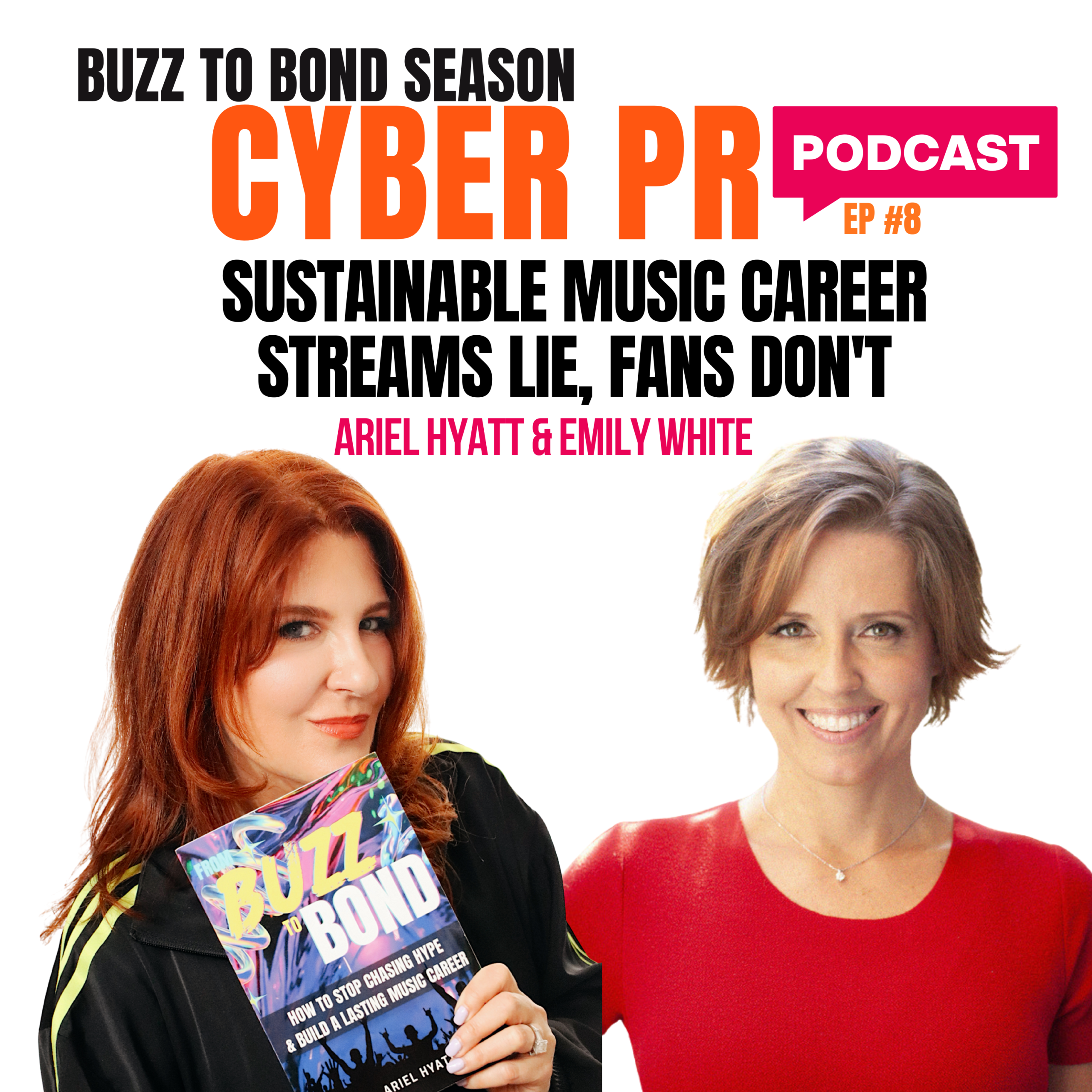
One of my favorite things about hosting a podcast on how to monetize music without streaming is getting to hang out with some of the smartest minds in the industry. Emily White, who is a return guest and was featured in season one, came over to my living room, and we chatted about something that mystifies us both: how an artist with millions of streams on Spotify and crazy follower numbers still can’t sell 20 tickets to a local show.
Emily White is someone who everyone throughout the industry respects. She cut her teeth while still a teenager traveling the country, witnessing one of the most successful indie bands crush direct fan marketing. Over the years, I’ve had the pleasure of being on both sides of the desk with her—witnessing her brilliant work as a manager and creative consultant, and representing her as her publicist. On top of running her nonprofit, Impact Data and Events, which uses music industry data to drive voter turnout, she wrote the bestselling book and hosts the hit podcast How to Build a Sustainable Music Career and Collect All Revenue Streams. She’s a repeat guest on my show because her perspective is always invaluable.
Table of Contents
Why do I have thousands of streams but no money to show for it?
Emily and I both wrote our books from a place of deep love for artists. We want to see you succeed, but we kept facing the exact same frustration: watching artists with 1.8 million streams struggle to sell 30 tickets to a local show. Until you own that fan contact info, streaming numbers stay just that: numbers.
“You are the product. They are never going to give you the mobile phone number. They’re never going to give you the email list.” — Emily White
“Most artists are chasing visibility. More streams, more followers, more buzz. That’s exactly why I wrote my book.” — Ariel Hyatt
Why identity has to come before monetization
Before any artist figures out how to make money, Emily wants them to get honest about who they actually are. “Brand” makes artists nervous, and for good reason: it usually just means chasing what everyone else is doing.
Brand pillars, minus the overthinking
Emily’s approach to finding clarity is surprisingly simple: sleep, daily movement, hydration, and a short meditation. In fact, she meditated for five minutes right at my kitchen table before we hit record. You might get brief traction by chasing what you think you should do, but long-term success only comes from being your genuine self.
Finding real fans instead of chasing the aggregate number
Emily draws a fascinating parallel between fans and voters. Her nonprofit built a data model with Johns Hopkins that maps trending artists in any location against the people there who are unregistered and non-voting. What’s playing in the Bronx is different from Staten Island, different again from three different Brooklyn neighborhoods. We live in a long-tail culture where everyone is inside their own algorithm, so the move is to stop chasing the aggregate number and go find the actual humans who are already drawn to your specific work.
Turn the platforms around: the tuneup and capture buckets
Step 2 of the funnel is the Social Media and Website Tuneup, and Emily starts it in an unexpected place: the art has to be amazing first, before any tactic matters.
Your art and your website come first
With a million songs released every week, your art is the reflection of your heart, your soul, your spirit. That’s what connects, before any marketing does. Skipping straight to promo is the mistake. Start with the art, connect authentically, then collect.
Why streaming platforms will never hand you real fan data
Emily brought in a line from Seth Godin, a guest on her own podcast and the person who literally invented permission marketing, about who these platforms actually serve, and it reframes the whole relationship. Her nonprofit’s voter work proves the workaround: they build direct-to-fan pages that collect phone numbers and emails directly, the same mechanism that works for releases.
Why pre-orders beat pre-saves
Step 4 is where Emily draws a distinction most artists miss entirely: pre-saves are not pre-orders.
Email is still hands-down the best way to make a living as an artist. Algorithms change daily, but your email list is yours forever. Emily recommends setting up automated welcome emails so every time a new fan signs up, they get a personal introduction to you right away.
What a long-lead pre-order actually is
The biggest artists in the world run long-lead pre-orders. That’s where the highest profit margins live, and where you collect the most usable fan data: an actual purchase commitment, not a passive save. Public follower counts and stream numbers didn’t even exist before the digital era. Sales figures used to run quietly in Billboard, an industry number, not a public scoreboard. A big number still feels good the way a hundred thousand potato chips feels good: great in the short term, not so great in the long term.
Writing to your list like it’s a real relationship
A direct email list gives you room a caption never will. Tell people why this release matters to you, why you’re excited to play their city. Some artists write full letters. Some go fully candid. Whatever the voice, it’s authentic, direct communication instead of paying Meta a fortune for a maybe-impression.
The five touchpoints that turn followers into paying fans
Step 5 asks how you move someone from passively following you into an actual superfan. Emily’s honest answer: you might not, and that’s fine.
Why some followers will never convert, and that’s fine
Don’t chase the passive ones. Pay attention to the fans asking, “When are you coming to Milwaukee?” Those are your people. Superfans want to support you, but they don’t know how unless you tell them explicitly: this pre-order is my heart, my soul, my child, this is the best way to support me.
The release-day sequence: text and email first, Spotify last
Sequencing matters just as much as the message. Most independent artists lead with Spotify on release day and walk away with fractions of a cent. Emily’s rollout runs in the opposite order.
| Day | Channel | What to say |
|---|---|---|
| Release day | Text list and email list first | “The bundle on my site, vinyl, handwritten lyrics, is the best way to support me” |
| Day two | Bandcamp | Share the release where fans can actually pay you |
| 72 hours after release | Spotify | Mention it last, after the direct channels have already converted |
Fan sanctuaries and monetization that follows connection
Step 6, Fan Sanctuaries, and Step 8, Monetization, close the loop: community first, income second.
What a fan sanctuary actually looks like
Emily lit up talking about J. Cole: driving around in a Honda Civic with a trunk sale of his own CDs, a dollar each. Compare that to needing a hundred thousand streams to earn a single dollar. A fan sanctuary doesn’t require scale. It could be twenty people at a local park, or fifteen people at your home the day your music drops.
Monetize what you’d cherish as a fan, not what you think you should sell
Ordering T-shirts or setting up Shopify isn’t step one. It’s a later step, worth it only once you know who’s buying. Start with the long-lead pre-order. Consider pressing CDs: Emily’s COO watched an artist burn live-show CDs on the spot and sell them for fifty dollars each, a hundred of them, unlimited technology made limited on purpose. Also worth building: experiences with no cost of goods, custom voicemails, recordings of live shows offered for donation. Think about what you cherish as a fan, then offer that.
Watch the full episode on YouTube
Key takeaways
- Streams don’t pay you. Direct fan data does, and until you own the contact info, the stream count is just a number.
- Pre-orders are not pre-saves. Long-lead pre-orders carry the highest margins and the most usable fan data.
- Identity comes before monetization. Being genuinely yourself outperforms chasing what you think you “should” do.
- Sequence your release: text and email first, Bandcamp on day two, Spotify 72 hours later.
- Monetization should follow connection. Don’t sell merch before you know who’s buying.
Show Notes
Chapters
0:00 Intro and welcome to the podcast 0:32 Welcoming Emily White and her mission to help artists build bonds, not buzz 0:39 Emily White’s background, her book, podcast, and the nonprofit Impact Data and Events 1:46 Why Emily wrote her book, “1.8 million hits” but can’t fill a room 2:23 Step 1, identity, and why brand pillars start with being your genuine self 4:02 Thinking of fans the way Emily’s nonprofit thinks about voters 5:57 Step 2, the social media and website tuneup, art first, data collection second 7:35 Step 3, capture buckets, and why “you are the product” on streaming platforms 9:53 Why stream counts and follower numbers used to be private, industry-only numbers 10:36 A quick word on the free Buzz to Bond training 11:04 Step 4, email list building, and why pre-orders beat pre-saves 12:51 Step 5, the five touchpoints, and the correct release-day sequence 14:48 Step 6, fan sanctuaries, from Diplo’s run club to J. Cole’s trunk sale 17:39 Step 7, repeatable systems and mining every interaction for fan data 18:29 Step 8, monetization, and why merch comes after the pre-order 20:27 Closing thoughts and where to learn more
About the Guest
Emily White is a bestselling author, podcast host, and founding partner at Collective Entertainment in New York City. Her book, How to Build a Sustainable Music Career and Collect All Revenue Streams, shares its name with her podcast. She also runs the nonprofit Impact Data and Events, which uses music industry data to increase voter turnout and drive impact for other causes through free concerts and digital activations.
Official podcast (Spotify): https://open.spotify.com/show/1fsLPVRMhI9EIMVH0PsNYt?si=912e8c97f1b44343
Instagram: https://www.instagram.com/emwizzle/
Business: https://www.collectiveentinc.com/emily-white
Resources mentioned
- From Buzz to Bond by Ariel Hyatt
- Buzz to Bond 7-Week Mastermind, live Q&A, next cohort launching soon!
- Free Buzz to Bond Webinar (instant replay)
- How to Build a Sustainable Music Career and Collect All Revenue Streams by Emily White
- Impact Data and Events
- Bandcamp for Artists (pre-orders)
If this hit home, the next step is simple. Come get inside the framework behind it. Watch the free Buzz to Bond webinar.
Listen and subscribe
| Platform | Link |
|---|---|
| Apple Podcasts | podcasts.apple.com/podcast/id1462931317 |
| Spotify | open.spotify.com/show/32BD52RAz9auVRc5NK1D3e |
| YouTube | youtube.com/channel/UCW4j-eMBG7OKfGX9zicSWjw |
Related episodes
- How to Build a Music Career on Real Fans, with Cassandra Kubinski (Episode 6)
- Capture Buckets: 7 Ways Musicians Can Stop Renting Fans (Episode 7)
- The Music Industry Has Been Lying to You About Success (Episode 1)
Visit the Cyber PR Music Podcast for a full list of episodes.
Artist Bio FAQ`s
Why do I have thousands of streams but no money to show for it?
Streaming does pay independent artists, but at a fraction of a cent per stream, it was never meant to be your sole income stream. On top of that, platforms like Spotify hold all your fan data. Real, sustainable income comes from direct-to-fan sales like pre-orders, merch, and exclusive experiences.
Why am I “the product” on streaming platforms?
Because those platforms make their money from your data and catalog, not from paying you fairly for plays. They will never hand you a fan’s phone number or email address. You have to build your own direct-to-fan systems—text lists, email communities, and direct sales—to build real relationships with your listeners.
What’s the difference between a pre-save and a pre-order for my music?
A pre-save is a passive action with declining value. A long-lead pre-order is an actual purchase commitment, and it’s where the biggest artists in the world generate their highest profit margins while collecting real, usable fan data.
When should I launch merch or a Shopify store?
Only after there’s a clear answer to who’s buying. Monetization should follow real connection and direct-to-fan data collection, not precede it. Long-lead pre-orders and low-cost, high-value experiences are worth building first.
What order should I announce my next release in?
Text and email lists first, since those are direct-to-fan channels you actually own. Bandcamp on day two. Spotify roughly 72 hours later. Most independent artists reverse this order and lead with Spotify, earning fractions of a cent for the effort.
What counts as a fan sanctuary, and do I need a big audience to build one?
A fan sanctuary is a space, physical or digital, where real community forms around you. It does not require a huge audience. Twenty people at a local park or fifteen people at a home listening party counts just as much as J. Cole selling CDs out of his Honda Civic. It can also be as simple as a WhatsApp or text group chat!
Why does my identity matter before I even think about monetization?
Because short-term traction from chasing what you think you “should” do doesn’t hold up long term. Fans connect with your genuine self, not a strategy. Get that clear first, and the monetization decisions get much easier.
What’s the one thing I should take away from this conversation?
Create great art, connect with your audience authentically, collect direct contact information (mobile numbers and emails), and communicate with them consistently about that art. Rinse and repeat. That loop, not the follower count, is what actually pays you.
Want to see the whole system in action? Watch the webinar now, instant replay!
Episode 8: Building a Sustainable Music Career with Emily White
Cyber PR Music Podcast | Guest: Emily White
Ariel Hyatt: I’m Ariel Hyatt, and this is the Cyber PR Music Podcast, dispatches for the new music business. This show is all about helping independent artists stop chasing buzz and start building bonds, real fan relationships that lead to income and long-term, fulfilling careers. Welcome.
I am so excited to have Emily White here with us today. Welcome, Emily!
Emily White: Thank you so much for having me.
Ariel: Most artists are chasing visibility. More streams, more followers, more buzz. That’s exactly why I wrote my book. Emily, you’re an ecosystem thinker, and I wanted to walk through today the first several steps of my nine-step Bond Marketing Funnel with you. But before we get into it, can you give us a little background on what you’ve been up to?
Emily: For sure. Like you, I’m a bestselling author. My book is called How to Build a Sustainable Music Career and Collect All Revenue Streams, and I host a podcast by the same name. I run a nonprofit called Impact Data and Events, which uses data in the music industry to increase voter turnout and positively impact other nonprofit causes through free concerts and digital activations. And I’m a founding partner at Collective Entertainment here in New York City, where my business partners do incredible work in management and consulting. That company also houses my books, speaking, and podcast.
Last year I got really angry, and that anger created a book. The anger was centered around having what felt like my millionth conversation about Spotify playlists and TikTok, and hearing artists conclude, “I got 1.8 million hits, but I can’t put thirty people in a venue outside my hometown.” I began to feel like we’ve lost the plot. We’re focused on the wrong things. In this episode, I want to focus back on the right things.
Step 1: Identity
Ariel: Step one of the Bond Marketing Funnel is Identity. I started here because if an artist doesn’t understand their brand, who their fans are, and what their voice is, we’re all building our house on sand. How important is clarifying your identity before diving into everything else?
Emily: I know what you mean, but I think the word “brand” can make artists a little nervous. Identity is really important. What’s going to be most effective for the long term is being your genuine self, that’s what connects with people. I wouldn’t overthink the brand piece too much. You have to listen to your intuition. I’m able to do that by getting a good night’s sleep, practicing daily movement, staying hydrated, doing a short meditation. I meditated for five minutes at your kitchen table before we started, and that’s where you can really find that inner voice. You might get short-term traction doing things you think you “should” do, but you’re not going to be successful long term unless you’re just being yourself. That’s the core of what a brand actually is.
Ariel: A hundred percent. And after you put words to your brand, there has to be a place where the brand meets the fans, defining and identifying who’s out there and why you should be connecting with them.
Emily: Absolutely. And it’s a fascinating parallel, I actually think of voters as fans. There are a million songs released every week, and we’ve built a data model with Johns Hopkins that shows the top trending artists in any location with the most unregistered, non-voting fans. What people are listening to in the Bronx is different from Staten Island, different from different neighborhoods in Brooklyn. We live in a long-tail culture where everyone is in their own algorithm. It sounds counterintuitive, but you need to be finding the humans directly, not chasing numbers. Someone who’s going to be interested in Ariel’s books or an artist’s music is going to be interested in that specific person. You need to find those people, not celebrate having 1.8 million views that lead to nothing. Tech companies are the most valuable companies in the world because they have all of our data. They’re using artists to fuel their businesses. We need to use those platforms to collect mobile phone numbers and drive people to our email lists. Use those platforms the way they’re using you.
Step 2: Social Media and Website Tuneup
Ariel: Perfect segue into Step 2: Social Media and Website Tuneup. If your fan journey is confusing, or if people don’t understand what they’re looking at, they leave. How do you help artists keep their online presence cohesive, especially when they’re constantly releasing new things with new looks?
Emily: Don’t forget the first step: getting your art together. When there’s a million songs released a week, your art has to be amazing. For the long term, that’s a reflection of your heart, your soul, your spirit in musical form. That’s what connects with people. Then think of yourself as a tech company, which sounds gross, I know, but treat your website like a machine for data collection: mobile phone numbers, email addresses. Connect with your audience as authentically as possible. Some artists have started podcasts because they wanted to share more about their music, more about their art. It’s easy to skip straight to marketing and promo, but start with your art, connect with your audience, and collect as much direct fan contact information as possible. That’s kind of it. That’s the bond.
Step 3: Capture Buckets
Ariel: Step 3 is what I call Capture Buckets. When you look at most artists, their capture buckets are owned by Mark Zuckerberg, Elon Musk, some company in China, or Google. That’s the giant failure point. How do you advise artists on capture buckets beyond the obvious “have an email list”?
Emily: Seth Godin was once a guest on my podcast, and he literally invented permission marketing. Not surprisingly, he said it better than I ever have. When it comes to streaming and social platforms, you are the product. They are never going to give you the mobile phone number. They’re never going to give you the email list. You have to turn those platforms around and create authentic bonds that aren’t just views or streams. Collect that information so you can communicate directly and cut through the noise.
What we do in the voting space is actually the perfect parallel. We’ve figured out which artists have the most low-propensity voters in their fan base. We partner with those artists, build scalable direct-to-fan voting pages, register to vote with this artist, register to vote with that one, and then we collect phone numbers and email addresses. With the artist’s permission, we send: “Early voting is open. Bring your friends to your polling location.” We take fans through the funnel all the way to election day. It’s exactly what you teach. You create that bond, you get that direct pipeline.
And think about this: public follower counts and stream numbers didn’t even exist before the digital era. In the pre-digital days, you could read sales figures in Billboard, but that was strictly an industry number. That information was private. It’s been turned on its head now. When you see a hundred thousand of something, it feels good. It’s like eating a hundred thousand potato chips, great in the short term, not so great in the long term.
[Mid-episode note: If you’re trying to figure out how to actually make money from your music, there’s a free training breaking down how to move from chasing streams and followers to building real fans who actually support you. Watch it at the link in bio or at cyberprmusic.com, click Free Webinar.]
Step 4: Email List Building and Growth
Ariel: Step 4 is Email List Building and Growth. There’s still so much resistance to this. Artists say, “It’s just a newsletter, I don’t want to bother people, I don’t like other people’s emails.” And there’s also confusion around text messaging services. What’s your take?
Emily: It goes back to authenticity. What are you trying to communicate? And I hope it’s not just “pre-save.” You should be monetizing your music before it’s even out, in the form of pre-orders. The biggest artists in the world are all running long-lead pre-orders. That’s different from pre-saves, and that’s where you’re going to have the highest profit margins and collect the most fan data. With a direct-to-fan email list, you have more space to actually say something meaningful. Tell people why this release is important to you. Why are you excited to play that show? Why are you excited to come to their city? There are artists who write full letters to their lists. There are artists who go fully candid and personal with their list. Whatever it is, those are artists being authentic, communicating directly instead of paying Meta enormous amounts of money for people to maybe see their post. It’s simple: create great art, connect with your audience directly, collect contact information in the form of mobile phone numbers and emails, and communicate with them about your great art. Rinse and repeat. That’s the bond.
Step 5: The Five Touchpoints
Ariel: Step 5 is The Five Touchpoints. How do you move someone from passively following you because of your cowboy boots or your cat to becoming a superfan?
Emily: Honestly? You might not. And that’s okay. Don’t worry about them. Pay attention to the ones who are asking, “When are you coming to Milwaukee?” Those are your people. Superfans want to support you in the best way possible, but they don’t know how unless you tell them. When you launch a long-lead pre-order, be clear: “This is my heart, this is my soul, this is my child. The pre-order is the best way to support me.” If you’re in the studio and don’t have a clear vision yet, launch a Patreon and bring people inside the process. On release day, tell your text list and email list first. Use your social platforms to say, “The best way to support me is the bundle on my site, vinyl, handwritten lyrics, fifty dollars.” On day two, share Bandcamp. Seventy-two hours after release, then mention Spotify. Most independent artists lead with Spotify on day one and walk away with fractions of a cent. Information is how you convert a passive follower into a fan. Otherwise, they just follow, and that’s it.
Step 6: Fan Sanctuaries
Ariel: Step 6 is Fan Sanctuaries. Every artist’s is unique. What examples have lit you up over the years?
Emily: Right now? J. Cole. He’s going around in a Honda Civic with a trunk sale of his CDs, selling them for a dollar each. Compare that to having to rack up a hundred thousand streams to make a dollar on streaming. He did a bike ride recently, and the Honda Civic broke down, so they all went to the mechanic together. His whole vibe is, “I’ll pick you up. DM me your address.” There’s so much artists can learn from that. You also see politicians walking the length of Manhattan and people saying, “I’m voting for you, I see you,” then those people shoot their own content and spread the word. When you’re talking about reach and fan acquisition and buy-in, there’s a lot to learn from how politicians build grassroots connection.
The terrible thing that happens is this idea that a hundred thousand of something is required for it to matter. A fan sanctuary moment could be inviting twenty people to a local park for a picnic. Or inviting fifteen people to your home on the day your music comes out for an appetizer party. It does not have to be huge. It has to be about creating community.
Step 7: Repeatable Systems
Ariel: Step 7 is Repeatable Systems. Artists struggle so much with consistency in marketing. What’s your take?
Emily: Create great art. Connect with your audience in authentic ways. The art has to be authentic too. Collect direct-to-fan contact info: mobile phone numbers and email addresses. And use those platforms the way they’re using you. Every interaction is an opportunity to grow that list. “When are you coming to Pittsburgh? Sign up for my text list, I’ll let you know.” If you have some higher price points, make sure you also have lower ones. You can make a million dollars with twenty thousand fans.
Step 8: Monetization
Ariel: And that leads us into Step 8, Monetization. We see this all the time, artists come to us and say, “I should order T-shirts. I should set up Shopify.” Should you? Who are you going to ask to buy this stuff?
Emily: Exactly. Just because you read somewhere that fans buy things doesn’t mean it’s time to sell yet. Think about the long-lead pre-order. You could even press CDs. My COO Annie Wu was recently at a show where an artist was burning live show CDs and selling them for fifty dollars. He only made a hundred of them, unlimited technology made limited. That’s a real revenue stream. And think about experiences that have no cost of goods: custom voicemails, recordings of your shows on Patreon or on your website for donation. Think about what you cherish as a fan and provide those experiences for your audience. That’s what connects, not the noise out here.
Even though these platforms are built to be addictive and create FOMO, if you truly can’t handle the FOMO, reach out to other artists. Get coffee. Hop on a Zoom. You might find out they have FOMO about what you have going on. Rising tides really do lift all boats. We’re one creative, artistic community. Share that knowledge. Ultimately, it always comes back to your great art and connecting with your audience.
Ariel: Emily White, I have no other questions. Thank you so much.
Emily: My pleasure. This was so much fun.
Closing
This is not about more followers or more streams. It’s about real fans who actually support you. If you want to go deeper, check out the free Buzz to Bond webinar in the show notes, or visit Cyber PR Music for over three hundred articles and strategies for today’s music business.
Less buzz, more bond.
Subscribe for more!

Back to The Blog