TL;DR Quick Summary
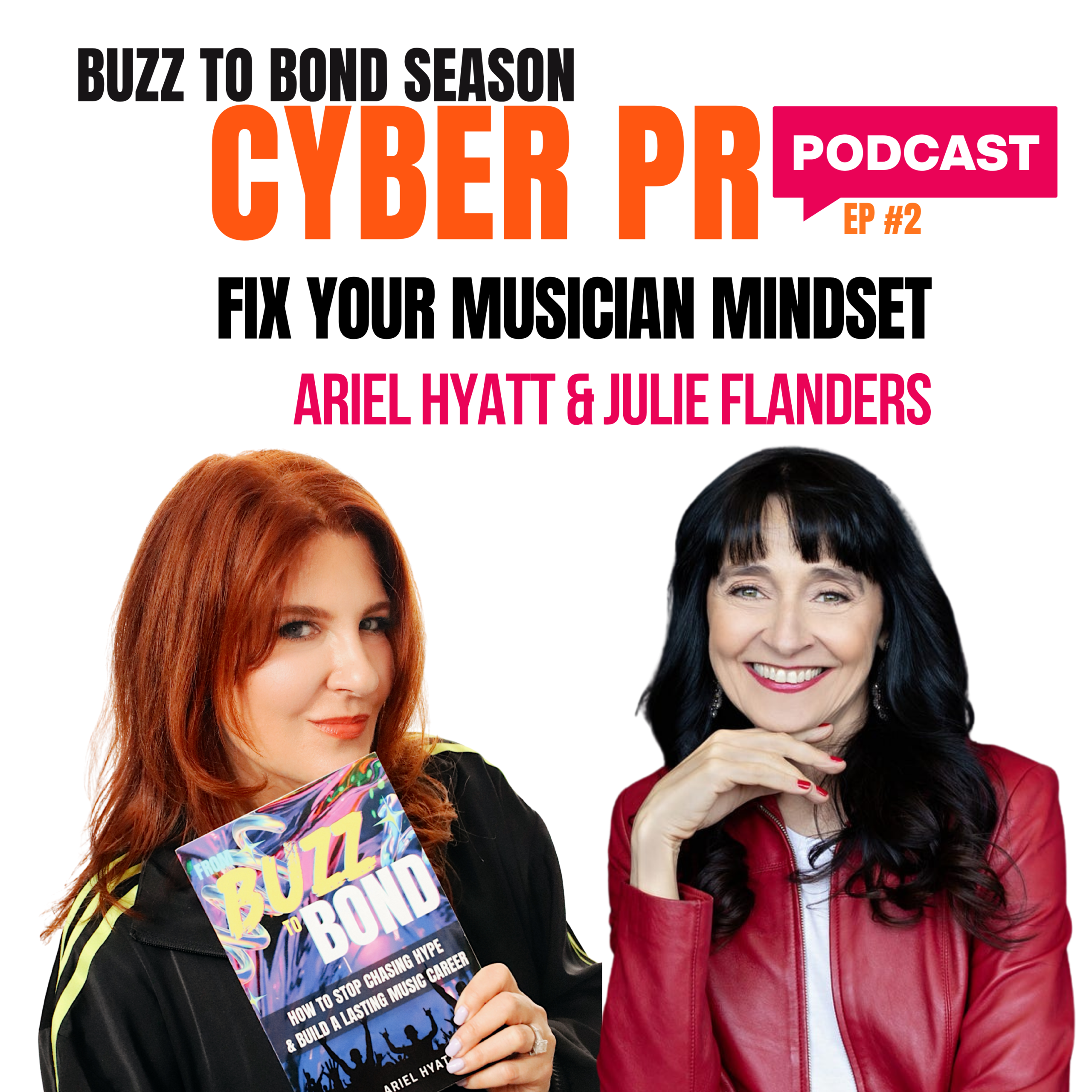
In Episode 2 of the Cyber PR Music Podcast, host Ariel Hyatt and guest Julie Flanders explore why internal mindset not vanity metrics like streams or follower counts is the real foundation of a lasting music career. They discuss how artist burnout comes from a flawed industry push for endless content creation, urging musicians to instead guide their decisions by asking, “How do you want to feel?” Drawing on October Project’s 30-year career, Flanders emphasizes that long-term stability comes from “bond marketing” building genuine, direct relationships with individual fans and cultivating self-validation rather than constantly chasing external approval.
Table of Contents
Why do so many independent artists experience burnout despite chasing higher streaming numbers and follower counts?
Burnout happens when artists build their careers around external metrics like algorithms, views, and streams rather than defining how they actually want to feel. Chasing constant content creation for social media creates a disconnected, exhausting hustle. Real sustainability comes from shifting from “buzz” (short-term attention) to “bond” (building authentic, direct relationships with a core fanbase) and grounding your work in self-validation.
By Ariel Hyatt | Cyber PR Music Podcast, Season 3 Episode 2
Nobody in the music industry ever asked you how you want to feel about your music career. They asked about your streams, your follower count, and your TikTok growth. But developing a strong musician mindset is the one thing that actually changes everything—and it is exactly where the industry has failed you.
Julie Flanders Is Not Just a Guest. She Is Someone Who Changed My Life.
Julie is the co-founder and songwriter of October Project, a band that has been making music for over 30 years. Over a million Spotify plays. Performances at Carnegie Hall. Worldwide virtual choirs with hundreds of participants from around the globe.
But that is not why I asked her on the show.
Julie is a dear friend who coached me through some of the most critical turning points of my career. She is intellectual and spiritual at the same time, which is a rare combination. She truly is an artist and she understands artistic people and those who support them in a way that most coaches simply do not.
We have traveled the country together, attending workshops and seminars. She has helped me break through some of my own deepest career blocks. She is an alchemist. A magical soul.
And she has been featured on this blog for years.

Her advice on making miracles with marketing and her guide to making money with music are two of the most-read posts we have ever published. Go read them after this.
But this conversation goes deeper than anything we have put into writing before.
The Question That Changes Everything
Early in our conversation, Julie said this:
“How do you want to feel?
That’s where someone’s essence lies. And then that tells you a lot about who you are.”
This is not a soft, fluffy question. It is the most strategic question you can ask yourself.
Here is what happens when artists skip it. They build their entire career around someone else’s definition of success. Streams. Followers. Viral moments. They hustle themselves into the ground chasing a feeling they never actually wanted in the first place.
The feeling is your compass. Measure every marketing decision, every platform choice, every release strategy against it.
Does this lead me toward how I want to feel? Or away from it?
That one question will save you years of wasted effort.
And here is the thing I really want you to hear: it is never too late to ask it.
Maybe when you started your career, you wanted to feel like partying hard, meeting people, drinking beer, and being a rock star. But now you are a family person with a completely different life and a completely different version of what success looks like. That is allowed. That is actually the whole point.
This is a journey. And this journey takes artists years.
There is no urgency here. When you align with the feeling you want to have, the other things begin to flow.
The Burnout Is Real. And It Is Not Your Fault.
I have never met an artist who is not experiencing some form of burnout.
It is basically the overwhelm of always being on. And it hits hardest at exactly the wrong moment.
Just when you have completed music you are proud of, you have to immediately create at least 30 posts per song. You have to track what works. You have to rinse and repeat.
And the platforms are so addictive that the minute you go on them, you are immediately distracted. The pressure to post constantly makes artists chase trends and shiny dopamine hits instead of staying on brand.
Here is the other thing nobody talks about. Musicians make music because that is the joy. The actual creation of the music is the joy.
Nobody got into making music because they wanted to create dozens of short clips and post them all over social media, hoping to see how many people liked them.
And then there is the noise. How often should I be releasing? How many tracks? How much promotion? How do I waterfall? You Google it, and there are hundreds of different gurus and blogs and podcasts and pieces of advice that completely contradict each other. You look at what other people are doing and it is just utterly confusing. That confusion alone leads to burnout.
The burnout is not a personal failing. It is a structural problem. And it is exactly what the Buzz to Bond 7-Week Mastermind is designed to fix.
Not by adding more to your plate. By replacing the chaos with a clear focused system that actually builds something real.

👉 Learn more about the Buzz to Bond 7-Week Mastermind — launching July 13, 2026
The Victory Dance. And the Punch in the Face.
Here is something Julie said to me that I have never forgotten.
She watched me set a goal, work incredibly hard, achieve it, and then immediately move on to the next thing without ever stopping to acknowledge what I had done. Keynote at SXSW. Speaking in Australia. A blog post or course that people genuinely loved. And every single time, just when I should have been celebrating, I would punch myself in the face while I was doing my victory dance.
She literally said that to me.
“You do your victory dance, and then you punch yourself in the face.”
It is a bit intense. But it was exactly right.
She kept saying, “What if you just allowed yourself to enjoy the fact that you did something that made you and others feel good?”
What if you enjoyed the dance instead of immediately throwing yourself on the floor and creating another goal?
It was profound when she pointed it out. And it made me realize patterns in my whole life: I was constantly pushing, driving, and forcing myself to the point of no return, always chasing the next thing, always tying my worth to the next achievement.
Always, underneath it all, looking for approval.
The Secret Weapon Nobody Talks About
Julie said something in this episode that I want every artist to sit with:
“If you want external validation because you think it’s going to fill a hole in your emotional life, you’re not going to be strong enough to get it in the first place. People who can self-validate receive more external validation than those who desperately seek it.”
Read that again. Slowly.
The artists constantly chasing approval from algorithms, gatekeepers, and follower counts are the ones who never quite get it. The artists who do the inner work, who trust their own creative instincts, who stop needing the numbers to tell them they are good enough, those are the ones who build real careers.
This is why mindset comes before everything else in the Bond Marketing Funnel. Before brand pillars, email lists, fan sanctuaries. Before any of it.
You cannot build something sustainable on a foundation of self-doubt.
How October Project Built a Fanbase with the Right Musician Mindset
Julie talked about what Sony told her early in October Project’s career. Don’t bring your real world into your music mythology. Stay mysterious. Keep it separate.
She ignored that completely.
“I don’t think our band would have built if I hadn’t taken the idea that every fan mattered. There was a moment when a fan became a friend, and you shared yourself with them in a different way. And that built the band.”
That is bond marketing. Before it had a name. Before I wrote the book. Before any of this existed as a framework.
Real connection. Real relationships. Real fans who showed up, came back, and brought others with them.
And then she said this. Tattoo it somewhere.
“Your record label can amplify what you do. But it will not give you anything you don’t give yourself. You must sell your first 10,000 albums yourself.”
And they did.
It Is Never Too Late
I want to say something directly to you before we get into the system and the strategy.
If you are sitting there thinking it is too late. That you already put the music out without thinking about any of this. That something you loved fell flat and did not get the numbers. That you blew your chance. That you are too old. That other people are getting something you somehow do not have.
I need you to hear this.
It is never too late to be inspired by your own creativity and art. It is never too late to reset. It is never too late to insert the question of how you want to feel into your journey, wherever you are in it right now.
Comparing yourself to others is the absolute worst thing you can do. And thinking that you destroyed a chance because you didn’t know about all this stuff will only hurt you.
There is no urgency here. This is a journey. And remembering your true north, getting clear on the feeling you want to have, before you dive into all the tactics, platforms, and strategies — whether you are building bonds, building buzz, or building both — that is the key.
“Want a practical starting point right now? Here is my complete guide: How to Promote Music in 2026
From Attention to Connection to Actual Income
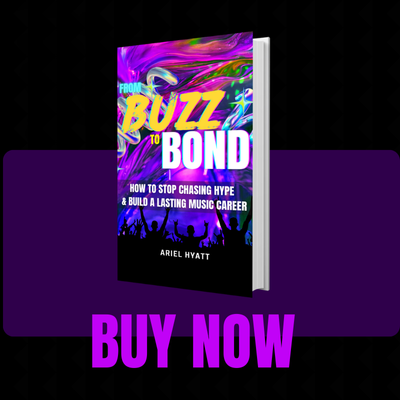
Everything Julie and I talked about in this episode comes back to the same idea at the heart of my book, From Buzz to Bond, and this entire podcast season.
Attention is not a career. Visibility is not income. Followers are not fans.
The shift from chasing metrics to building real relationships is not just a marketing strategy. It is a complete reorientation of how you think about your music, your audience, and your career.
It starts with a feeling. It starts with a question. It starts with deciding you are done building on rented land and ready to build something you actually own.
📗 Grab From Buzz to Bond on Amazon: Number one bestseller, perfect five-star rating.
The Bond Marketing Funnel: Where Mindset Meets Strategy
Once your head is right, the system kicks in.

The Bond Marketing Funnel is the 9-step framework I developed over 30 years of working with independent artists. It is the backbone of this entire podcast season and the core curriculum of the Buzz to Bond 7-Week Mastermind.
Step 1 is Brand Pillars, Fan Personas, and Voice. Who you are, who you serve, and how you communicate. Nothing else works without this.
Step 2 is Social Media and Web Tuneup. Aligning your digital presence so attention does not leak out through the cracks.
Step 3 is Capture Buckets. Systems that turn fan attention into email subscribers and real contacts you actually own.
Step 4 is Email List Building and Growth. Your most valuable asset. Unlike social media, you own it forever.
Step 5 is The 5 Touchpoints. Fans need to encounter you five or more times before they truly bond. Here is how to intentionally create those moments.
Step 6 is Fan Sanctuary. A dedicated space for your most engaged fans, away from the algorithm, built around real community.
Step 7 is Repeatable Strategies. Systems that prevent burnout and create long-term momentum instead of release-cycle spikes.
Steps 8 and 9 take you into Interactive Community and Consistent Sales. The natural result of a bonded fanbase. People who want to support you and know how.
Mindset is what makes all of this possible. Without it, the system is just another checklist. With it, it becomes the foundation of a real career.
Key Takeaways
“How do you want to feel?” is the most important question any artist can ask. And it is never too late to ask it.
Burnout is not a badge of honor. It is a signal that your structure is wrong.
You do your victory dance, and then you punch yourself in the face. Stop doing that.
Self-validation is the secret weapon. Stop needing external approval to feel worthy and watch what happens.
Bond marketing worked before it had a name. October Project proved it by treating every fan like a friend and building a 30-year career on real relationships.
It is never too late to reset. Never too late to ask how you want to feel. Never too late to build something real.
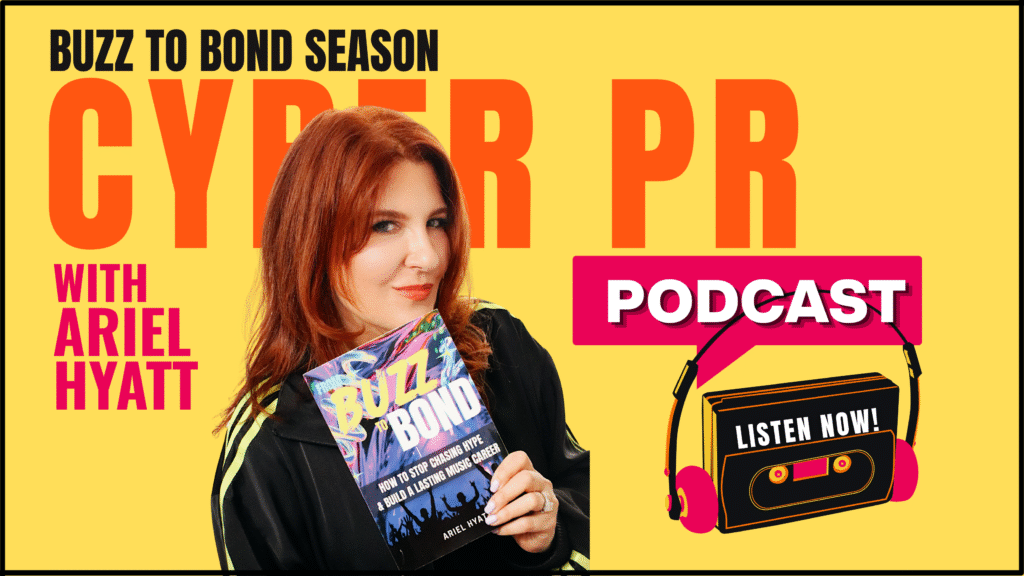
Listen to Episode 2 of the Buzz to Bond Cyber PR Music Podcast
Watch on YouTube – Please subscribe while you are there 🙂
Frequently Asked Questions
Why does mindset matter for music marketing?
Because every marketing decision flows from how you think about yourself, your music, and your audience. Artists who market from a place of desperation build nothing sustainable. Artists who market from a place of clarity and self-trust build real, lasting fan relationships. Mindset is not separate from strategy. It is the foundation of it.
What is the Bond Marketing Funnel?
The Bond Marketing Funnel is a 9-step framework developed by Ariel Hyatt of Cyber PR Music for helping independent artists move from chasing metrics to building a bonded fanbase. It covers brand identity, digital presence, audience capture, email marketing, five key touchpoints, fan sanctuary creation, repeatable strategies, interactive community, and consistent sales.
How do you know if you are experiencing music marketing burnout?
If you are posting consistently, releasing music on schedule, promoting endlessly, and feel completely disconnected from why you started making music, that is burnout. It is not a personal failing. It is a structural problem. The solution is not to push harder. It is to replace scattered effort with a focused system built around real fan relationships.
Who is Julie Flanders?
Julie Flanders is the co-founder and songwriter of October Project, a band with over 30 years in the music business and over a million Spotify plays. She has worked at every level of the industry — major label, indie, and full DIY — and now coaches creative entrepreneurs on mindset and sustainable success. She has been a mentor and dear friend to me personally, and one of the most important voices in my career.
What is the Buzz to Bond 7-Week Mastermind?
It is a small-group live experience where independent artists build their entire fan base step by step over seven weeks. Weekly coaching, accountability, direct feedback, and action sheets so you always know exactly what to do next. The next cohort launches July 13, 2026. The investment is $850, with payment plan options available.
Is it too late to start building a real fanbase?
No. It is never too late. Whether you already released music without a plan, whether something you loved fell flat, whether you feel behind — none of that matters. It is never too late to reset, to reconnect with why you make music, and to start building real relationships with real fans. The journey takes time. That is not a problem. That is the point.
What is October Project?
October Project is a band co-founded by Julie Flanders and composer Emil Adler. They have been making music for over 30 years, signed to Sony before going fully independent. They have performed at Carnegie Hall, created worldwide virtual choirs, and built a devoted fanbase through decades of genuine fan connection — without buying their way in.
Where to Go Next
If this episode hit something true for you, I want you to go deeper.
Buy From Buzz to Bond – it’s short and sweet, a quick read, I promise Amazon
Watch the free webinar: 45 minutes, no hype, just the full Buzz to Bond system. Watch here
Join the Mastermind: New cohorts launch regularly. Enroll here.
Less buzz. More bond.
[ + ] Click Here to Read the Full Episode Transcript
Cyber PR Music Podcast Season 3 Episode 2: Getting Your Mindset Right with Julie Flanders
Cyber PR Music Podcast | Guest: Julie Flanders
Ariel Hyatt: I am Ariel Hyatt, and this is the Cyber PR Music Podcast. Dispatches for the new music business. This show is all about helping independent artists stop chasing buzz and start building bonds. Real fan relationships that lead to income and long-term, fulfilling careers.
Welcome to the… I don’t even know what season it is of my podcast. It’s the winning season. It’s the winning season because you’re here. Oh, and because I have a new book. And because I’m so psyched you’re here.
Julie Flanders: It’s a great new book.
Ariel: Thank you. So what we’re doing this season is unpacking From Buzz to Bond, and we’re focusing on the Bond Marketing Funnel, which we have many episodes to get to. But the reason Ms. Julie Flanders is here today, not only is she my mentor and my friend, she’s an extraordinary musician in her own right who has had every flavor of musicianship, from being signed to Sony, to world tours, to making music in her own living room. The full spectrum. And you’ve shown that longevity is possible, that having a lifelong career is possible.
Julie: And it has not been easy. All those years have not been salad days.
Ariel: Yes. But the reason Julie is here today is she comes into the room before we can begin to unpack marketing and strategy, because she’s all about mindset first. Julie, welcome.
Julie: Thank you so much.
Julie’s Journey: Music, Business, and Hypnosis
Ariel: Before I start bombarding you with questions, because I’m boiling over, can you give us an introduction? I always hate reading the hundred-word bio. Tell us a little about your musical journey.
Julie: I grew up doing music. It was my thing. Music and running track, which are both, for me, solitary activities. I practiced and practiced and practiced, and I ran. I went to school thinking I was going to study classical music, and I got there and found out that wasn’t what I was going to do. So I broadened out into other creative areas: theater, acting, and all kinds of transformative art forms, including my primary one, writing. As a result of immersing myself in so many different ways of learning, one of the things I picked up was hypnosis and trance states, which are incredibly powerful for creative flow, for connecting with something that broadens, deepens, and widens a person’s perspective and options. When I came out of school, I don’t think I’d learned that you don’t automatically go from being a creative person to knowing what to do with it.
The Foundation of October Project
Ariel: Where in that journey did October Project, the band you founded and that still exists today, come to light?
Julie: It’s interesting, because what ended up happening was I got a day job as an executive recruiter. I’d had a little job in PR first, worked in that for two or three years, then moved into executive recruiting, and as a result I really learned business. That was the first time I realized creativity wasn’t limited to the arts. I was looking for people to help invent what was called “home banking” at the time, but it turned out to be the content that would animate the internet. I was looking for people who could think in technology and bring that through their creativity into forms that existed but hadn’t been used at home. Because why would anybody ever use a computer at home, right? I was helping people understand why you’d want to.
Ariel: And how did that translate into a band?
Julie: The economy changed, and my boss said, “This economy is going to change. You already care more about the people looking for a job than the people paying you to find somebody. Why don’t you start something to help people who are looking for a job?” There was no such thing as career consulting at that time. I was at a boutique executive firm, and I started a career counseling area. To do that, I had to study a lot, and I applied it to myself. I realized I was unhappy in business. I started a band and acting school in the same year. The first person I really learned this from was Barbara Sher. Do you remember her?
Ariel: Yes.
Julie: She had this idea: you can’t do it the way other people do it, you have to do it your way. I internalized that, applied it to myself, applied it in the world, and started teaching it. By the end of a year I was in a full-time acting program, starting a band, and counseling people, and the band took off.
Success at Sony and Café Sin-é
Ariel: And then you got a deal with Sony.
Julie: We did. And it wasn’t day one. It took a long time to find our voice and put it into the world the way we intended. We played all over the city, but we became residents at a tiny café called Café Sin-é. I also had this idea that the best way to move in the world was to help other people, so I used to put together evenings with three artists, and we’d all agree to bring an audience for each other’s projects. Each project was different, but they’d all appeal to the people who came. We filled the house; we played with each other. At Café Sin-é, we played with an artist named Jeff Buckley, who became super famous, signed a week or two before or after we were there.
Ariel: Yeah, and his famous album, which I did publicity for. My first job in the music business.
Julie: I don’t think I knew that.
Ariel: Yeah. You and I have all these amazing sliding doors. My first job was working for Katherine Schenker and Live at Sin-é.
Julie: Wow.
Ariel: Jeff Buckley was her developing tiny artist. She had Sting, Peter Gabriel, Tina Turner, INXS. It was incredible. Anyhow, I digress.
Julie: No, but it’s that kind of thing, the synchronicities of the people you resonate with following you across time. It matters. And I’ll tell you, in my executive recruiting job, everybody I helped came to my gigs. When I started to make the transition, I didn’t think those two worlds had to stay separate. Sony told us, “You can’t bring your real world into your music mythology.” I completely disagree with that now. I don’t think our band would have built if I hadn’t taken the idea that every fan mattered, that there was a moment a fan went from being a fan to being a friend, and you’d share yourself with them differently. That built the band. Someone also gave us very wise advice: “Your record label can amplify what you do, but it will not give you anything you don’t give yourself. You must sell your first ten thousand albums yourself.”
Ariel: And you did.
Julie: We did. We were all in. And that’s the thing I’d tell artists: you have to be all in. If you’re even one molecule less than all in, work on that. Give yourself more support, more nourishment, more reason to do what you’re doing.
Mindset Before Marketing
Ariel: This is the thing that’s honestly alarming about how creation happens now. Something brews and happens, and then it immediately goes on the internet. You have to show behind the scenes, show you’re in the studio, show something’s happening. Marketing is so confronting, and it’s so hard to get right. It’s not just vomiting your soul all over every camera you can stand in front of. I keep coming back to this: how do artists get their mindset right? Sustaining a long-term career won’t happen unless you understand you’re in this for the long game, that it might take five, eight, nine, ten years just to reach what everybody else thinks is the starting line.
Julie: I’m launching a project right now that I originally wanted to do with all live musicians, specifically because that felt counter to everything happening around us. Then the pandemic hit the week we were scheduled to start in the studio. So instead of live musicians, we made it in a tiny capsule of a home studio, trying to make it feel grand anyway. Now, years later, after finally adding live musicians, it’s coming into being. It’s more fully formed creatively because of the wait. I think when people put marketing before their creativity, they fall out of love with their career, unless marketing genuinely is their creativity. You have to be in love with what you’re doing, because it’s hard enough that you need that love. For me, the love comes from the work itself. When you’re doing something that really serves your career, you don’t get tired from it the way you do when you’re forcing yourself. Burnout is a sign you’re making yourself do something that isn’t right for you.
The Fundamental Question: “How Do You Want to Feel?”
Ariel: When you were mentoring me, you taught me something that’s one of the most valuable lessons I’ve ever learned, and one I love passing on to artists. We’re so busy worrying about the voice, the brand, the fans, the marketing, the advertising, the release dates, the waterfalling, getting it all out into the world. I remember I was traveling constantly, speaking, writing books, and I’d come home and have a session with you, sort of flailing, and you asked me a simple question that grounded me and still shapes how I advise artists: “How do you want to feel?” Why are you doing all of this? I still have to ask myself that.
Julie: Yeah, because I think that’s where the essence of someone is. It tells you a lot about who you are. If you ask somebody what they really want, a lot of the time they can’t answer it, or they answer with something that isn’t really possible: “I want to play the Super Bowl,” “I want to be on SNL,” “I want to be on the cover of Rolling Stone,” “I want a massive review in Pitchfork.” And the real question underneath that is, why do you want that? If you want it because you think it’s going to fill a hole or a deficiency in your emotional life, you’re not going to be strong enough to get it in the first place. What you actually want, underneath that, is usually some form of validation. And if you can self-validate, you’re already ahead. So it comes back to the feeling. When you find the feeling and know it’s right, you can use it as a compass. Is this leading me toward that feeling, or away from it? I just had an artist I was working with who’d been told all sorts of things that might be theoretically true, but this artist wants to perform live, wants people in the room. There are a million ways to build a strategy that doesn’t require that. But telling a performing artist not to perform, because it makes more sense to a digital marketing person, is wrong for that person.
Ariel: No question. And the digital marketing person might even be technically right, based on what we’re told about algorithms right now. But there are two things you wrote about in your book, From Buzz to Bond, that I think are genuinely valuable. One is the composite character I call John Dough. He has the resources to buy the ads, force the flow, and then nothing comes back.
Julie: Right.
Ariel: So how is he actually feeling? This person, John Dough, is very privileged, made a lot of money, and is making music now, actually really good music. He’s been on the road with famous people. He’s hired a huge team to do buzz strategy. A million plays on Spotify, hundreds of thousands on YouTube. Everything looks great from the outside. Now it’s time to go on tour, and no booking agent will touch him, because he cannot draw.
Julie: Right.
Ariel: He goes into a venue and there’s no physical correlation. It doesn’t manifest.
Julie: Right. You can’t pull it out of the air.
Ariel: That was a huge eye-opener for me, getting to go behind the scenes with an artist client who has seemingly unlimited money. You’d think that buys you the front of the line. But bond marketing and bond creation aren’t sexy. It’s a long game. It’s figuring out how to deeply connect with your audience, and part of that is knowing who your audience actually is. A lot of people want their audience to be different than it is.
Knowing Your Real Audience
Julie: That’s true. There’s a natural audience for what you do. If there isn’t, maybe it stays a hobby you do for yourself. But if you’re going to put it into the world, there has to be a place where what you offer meets somebody who wants to receive it. A lot of the people doing marketing, when we started, were pretty dismissive of anything by women. Our music wasn’t appealing to certain boy marketing executives, and they couldn’t see beyond what they personally liked. If it wasn’t for them, they couldn’t imagine how to market it. I’ve dealt with that a lot with different artists over the years. A really good marketer doesn’t have to personally like something to see who else might. Take an artist who sounds a lot like October Project, or like Ethel Cain, Mazzy Star, Portishead. If you don’t think that kind of music has legs, you don’t understand how successful it can actually be. John Dough is probably not really asking, “Who would genuinely want to hear this?” There are bands that never wanted to tour at all, who built an entirely online presence instead. I think that’s legitimate too, these days.
Ariel: I think so too. It’s not about “this way or that way is the only way.”
Julie: No. And you can’t get tired of looking for new ways to do it.
Ariel: I know. The only predictable thing I’ve noticed, thirty years into this business, is the guarantee that the game will always change. And the question you asked me is still the right one: how do you want to feel? It could be happiness, satisfaction; that was my guidepost. I wanted to feel elated. We work with a lot of Christian artists, and their vision is that they want to feel like they’re spreading a message; that’s their motivation. We work with artists who’ve gotten clean and sober, and they want to show future generations that you can lead a genuinely happy life after coming through the darkness of addiction. Everybody has a different flavor of the feeling. But the feeling can never be a million hits. It’s not a number on YouTube. It can never be whatever you currently think success looks like.
Julie: People come to you all the time needing exactly that, a revisioning of the goal, and a replenishing of the energy that motivates it. If you’re going to locate how you want to feel, the next question is: how do you want your audience to feel?
Closing
Ariel: This is not about more followers or more streams. It’s about real fans who actually support you. If you want to go deeper, check out the free Buzz to Bond webinar in the show notes, or visit Cyber PR Music for over three hundred articles and strategies for today’s music business.
Less buzz, more bond.
Subscribe for more!

Back to The Blog