TL;DR Quick Summary
In part 2 of her 3-part series, Cyber PR founder Ariel Hyatt takes artists through the next five steps of her album release marketing plan to ensure artists stay organized and get the most out of their release.
Table of Contents
What are the essential components of a music release marketing strategy?
These Musician Marketing Plan posts are the most popular series on this site. They are fully updated for 2024.
Do you have a plan for your next music release? This can be a single, a music video, an EP, or an album. In our most popular series, The Musician’s Guide to Marketing Plans, which we call Total Tuneups, we address the overlooked importance of having a marketing plan and go through the first five of fifteen elements to keep in mind when building a long-term strategy.
Here in Part 2, we break down the next five elements for your music release so you don’t miss a single opportunity.
If you didn’t get the chance to read through Part 1 – The Nuts & Bolts, please do so before reading this. This series comes from years of collaborating with record labels and brilliant managers. What we noticed separates the best artists and teams who get results vs. those who are floundering during their music release is planning.
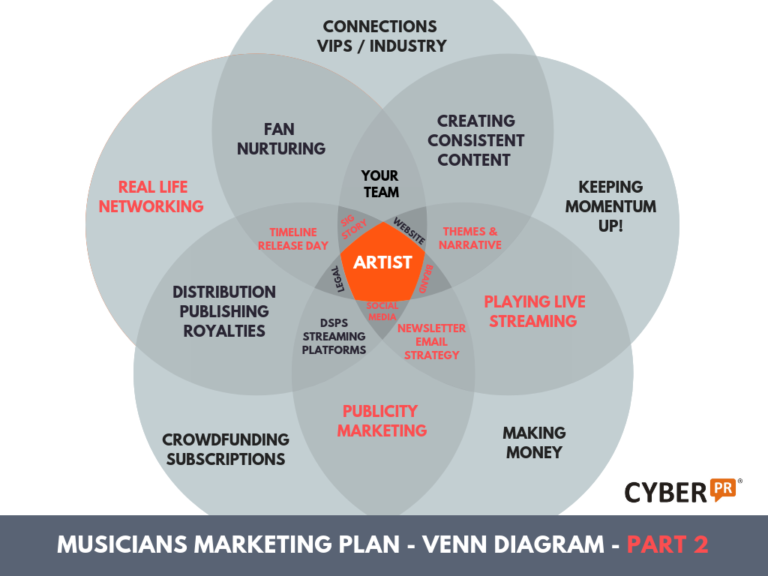
Musician Marketing Plan Guide Part 2 – Music Releases
Look at the Part 2 VENN diagram above, which visualizes your Musician Marketing Plan. For each part, we have highlighted the sections we are covering in red so you can see how all of these parts work in concert with one another for your music release.
The Second Five: Planning Your Music Release, AKA Ordering the Chaos

In the past, labels were more focused on artist development. They had entire departments dedicated to planning and growth. In today’s climate, artists are expected already to have a fanbase, numbers, and revenue before they even think about contacting a record label. Even if getting signed isn’t on your to-do list, these tips will help keep your career going steadily in the years to come.
A music marketing plan is comprised of 15 elements. Five of these elements are specific to getting squared away before announcing a release. To check off all of the 89 elements, we have broken them down for you in our Music Marketing Plan Checksheet as a companion to this series.
6. Timeline
7. Music Release Day
8. Publicity & Marketing
9. Playing Live / Streaming
10. Real Life Networking

6. Timeline – Your 12-Week Music Release Tasks
Planning is everything, as you can’t stuff the genie back in the bottle after the release is out! If you struggle with managing your time, this will help.
Three Months Before Music Releases
Register With A Performing Rights Organization.
You probably already know this, but just in case—to collect your royalties, you’ll need to sign with a Performing Rights Organization (“PRO” for short) and SoundExchange. The two options in the U.S. for PROs are ASCAP and BMI.
For live royalties, BMI and ASCAP both offer portals to collect royalties from playing live. Once your songs are registered on the PRO database, you log in and enter any dates you have performed them, where they were performed, and which songs. The PRO companies payout quarterly so be sure to enter the performances soon after they are through, otherwise, you could miss a deadline!
You must also register with SoundExchange, which focuses on royalties for your recording (mechanical rights), while your Performing Rights Organization focuses on royalties for your song (performance rights). Try to do this before the music is released.
Document the Recording & Creation Journey For Your Fans
What may feel mundane to you – writing, recording, mixing, mastering, being in the studio, etc. can be really exciting for your fans. Taking them on a behind-the-scenes journey of this music release is a great way to form a stronger bond with your current and growing base.
Send updates on how the recording, mixing, and mastering is going using videos and photos via your social media, plus capture longer-form stories for Instagram Stories and your newsletter.
Engage with your following on milestones like artwork and song titles by polling your fans and holding contests to select what cover or title to go with, have your fans weigh in on photos, graphics and get them involved with the process. All this activity aims to get people excited so they are engaging and sharing your updates.
Choose Your PR & Marketing Plan
A big component of music release is getting PR. You can accomplish this by hiring a team or by doing it yourself.
When hiring a PR team, ensure you do your homework and that your music fits that firm’s approach and philosophy. Be sure that the team talks to you about their well-thought-out plan for your campaign.
A PR company should work with you to ensure you are fully prepared before being introduced to the press. This is the first part of their job when you engage a firm.
If you’re going with a do-it-yourself approach, here are some tips for an effective music PR campaign:
Choose Your Playlisting Plan – Submit Your Music Directly to Spotify

Sign in to your artist account and you will see the prompts. When submitting, take extra care to give a detailed description of the song, supplying any relevant information about the song to easily guide editors to the best place for your music. Here are 2 examples of submissions and a full post packed with tips where the track ended up being featured on Spotify editorial playlists.
Build Your Playlisting Initiatives
If you don’t know all the steps to set up a playlist, follow this step-by-step guide. Start building and sharing playlists. You need to build up plays, as this impacts the current song you promote and any forthcoming singles. Use interesting titles and themes to grab people’s attention and aid with your search.
Find Playlist Curators & Pitch
Of course, this is easier said than done! It is not easy to find curators, but it is possible with some dedication. Google and all the Socials are great places to start. Reddit has an active Spotify Playlists Page. There are also quite a few on SubmitHub that you can access for a small fee.
You can also use a site called Playlist Supply. It’s essentially a search engine for Spotify playlists. It’s meant to be an easier and more streamlined way to contact playlisters rather than hunting around Spotify to find them manually.
Two Months Before Music Release
Get Great Photos
Make sure you have at least 3-4 great images, and variety is important. Most music blogs feature square or horizontal photos. When getting photos taken, think through your brand and consider variety to keep your images fresh as time goes by.
Finalize your Single / Album / EP Artwork

Your artwork should be ready and look on-brand and amazing! Ask your designer to animate it for Reels and TikTok, break it up into tiles for Instagram, and of course, resize it for all your social posts (use Canva, it rocks).
Consider FOREVER or Evergreen Pre-Saves
Forever Saves is a feature on Symphony that makes it easier for fans to access new music from their favorite artists. Once a fan subscribes, they automatically receive new songs in their library as soon as they’re released. This tool boosts streaming numbers and collects useful fan data like emails and locations, helping artists connect more directly with their audience. It simplifies the music release process and enhances fan engagement without the need for repetitive pre-saves.
Pre-saves are a smart addition to any music release strategy, especially with the flexibility offered by a Feature.fm Evergreen Pre-Save campaign. This type of campaign allows artists to plan for releases without a set song or date, adapting easily as plans evolve. Pre-saves are quite beneficial, boosting early saves and growing artist followers while collecting valuable fan emails. The Evergreen Pre-Save works just like a regular pre-save but without a fixed release date, making it ideal for capturing attention from viral moments on platforms like TikTok. Setting up an Evergreen Pre-Save is straightforward and keeps fans engaged by promising early access to future releases.
TIP: I don’t recommend going crazy on Presave campaigns asking everyone you know to click unless you have a very active community on Spotify, but you should always create a presave for those who like and use them.
Focus on Increasing Your Audience
If you have been recording new music, you may have neglected the constant grind of keeping your social media and email list growing. This requires a lot of heavy lifting, and your whole band or team should be helping.
If you have not kept up consistently, find friends and people you admire (bloggers, other artists, venues, local spots you like to hang out in, etc.) on Instagram, TikTok, Threads, and Facebook, and friend away!
This will increase your audience because as many of the people you follow will follow you back. Also, start reaching out to people in your inbox and outbox and getting them on your list (remember it’s illegal just to sign people up, so do this with integrity and ask each person). Your newsletter is the place where you will be able to monetize, so don’t skip this step.
Prep Your Content Calendar
Your content calendar outlines all the assets you need for your release and dates for each asset/action needed. Countdowns, art reveals, listening parties of live release party announcements, ticket links, and calls to action (like Spotify pre-saves) are all fodder to add to your content calendar.
Use my SMM Organizer to capture all of your posts and your VIPS. This will help you keep track of all the content that you will post. You can see there is a tab for each platform. If there are several of you in a team or a band, assign one platform per person. You will also see a VIP tab here where you will add industry people you need to connect with in real life (more on that below).
Six Weeks Before Music Release
Submit Your Music to Your Distributor
If you are leading this music release with a single (or many), make sure to let them know you are releasing a single(s) FIRST before the EP (if this is the case). You must have your single artwork ready at this time! Tunecore, DistroKid, CD Baby, and other aggregators can take 4-5 weeks to pitch your music to Spotify, Apple Music, Google Play, Amazon Music, and other digital service providers (DSPs).
Launch a Facebook Like Campaign and Instagram Ads to Get More Followers on Your Pages
If you haven’t done so in a long time, go through your personal Facebook page and ask all of your friends to like it. I know this may seem crazy to do during a time when Facebook is catching a lot of heat, but promoters, venues, and music bloggers still look at social numbers, so make sure yours are consistently growing (and don’t buy fake fans ever!).
Releasing Singles
This is a great way to build buzz, get fans excited, and get some music bloggers and playlists interested. Any reviews you can place will help build your overall online profile.
On the press side of the house, aim for appropriate blogs. If you are a brand new artist, Pitchfork is probably NOT appropriate. Go for smaller, more targeted music blogs!
That said, reach out to your “within reason” dream targets with your single(s).
Album reviews take a considerable amount of time, and if you look, most music sites are reserving these full album review slots for the most anticipated albums, so don’t feel disappointed if you don’t get full album / EP reviews (they are not en vogue these days)
Announce a Music Release Event: Live Show or Listening Party
If you play live, book a release show and do something to make this show more special than the others. Decorate the venue, work with the bar to create a special cocktail, pre-sell a merch pack, hire a party bus, ask a food truck to pull outside the venue, etc.
If you don’t play out, create a listening party at a small bar, create an after-work happy hour, or choose a local favorite coffee shop. If you are just starting and don’t think you can draw a large crowd, hold a listening house party with wine tasting, cupcake bake-off, fondue party, etc. Think about your fans and make this special for them. And, of course, the key is to announce that tickets are on sale and share links!
Launch Your Music PR and Playlisting Campaign
This is a great way to build buzz. If you are hiring a PR team, this will be the time they launch.
Two Weeks Before Music Release
Build the Momentum!
Keep the excitement up on your socials by scheduling countdowns across your socials.
Write your ‘Day Of’ email so it’s ready to go out.
Hold a contest to win the new music or give away tickets to your show or listening party.
7. Music Release Day – Be Ready For It
Prep Your Website:
- Change the artwork on the landing page to announce the new music
- Add an announcement to the News section (if you have one)
- Add link to new single or player if you feature music
- Add video to video page (if you have a video – your distributor may have created one for you )
Skin ALL socials with “out now!”
- Use Canva to resize your design for each site
- Create CTAs for each platform to post as well
Instagram:
- Change your bio and LINK to announced include the release – add a musical note or an appropriate emoji, too! Add a streaming link and CTA to listen
- Create a release tile, post with the album / single art, and say “out now.”
- Create an Instagram Reel and post it on your Stories
Facebook:
- Make a fun video about the release – and Boost!
- Boost or Buy an Ad announcing the release to your fans and a lookalike audience
- Edit the “About” section to include the new release
- Post a status update announcing your release, and pin it to the top as a timeline feature.
- Go to Facebook Live and talk about the fact that the music is available and ask for fan feedback
Spotify:
- Header and Profile Photo: Keep these up to date and in line with the rest of your social profiles.
- Image Gallery: Choose images most aligned with your brand and recent music.
- Social Media Links: Add links to your social media. Here’s a Spotify how-to and an image gallery on adding those.
- Spotify Bio: With 1500 characters to share with your fans, you can update this whenever possible. Include shows, notable press, and new singles in your bio.
- Add an Artist’s Pick: You can designate a song, album, or playlist as the “Artist’s Pick.” This will appear at the top of your profile with your note. You can add a custom image to your Pick or share tour dates if preferred. Read more here.
- Make sure to create and upload a Spotify Canvas on release day
Twitter/ X/ Threads:
- Post out your release announcement
- Pin the Post to the top of your profile page
- Go to Buffer and program 1-3 times a day for the next 10 days
- Start conversations around releasing music on Threads and interact
YouTube:
- Customize the top banner profile picture to announce the new music
- Add your bit.ly link and mention of the release to the “About” section
- Upload cover art and have track streaming in the background
Email:
Send out an announcement to your mailing list. THIS IS THE MOST IMPORTANT STEP as many people won’t see your social posts (thanks to the algo!)
8. Publicity & Marketing for your Music Release
PR takes time and effort to execute well. Sadly, many artists believe that PR = blasting a press release out to the top 100+ music sites they Googled. This never works, because PR placements start with astute research.
Bio / Signature Story
The cornerstone of your brand is your bio. You will need a solid story to build your marketing and PR. We suggest hiring a professional to write your musician bio, which we call a signature story around here. Even if you are a strong writer, it can be challenging to write about yourself. A professional writer will be able to craft a compelling bio that effectively conveys all the important details while keeping the audience in mind, which in this case includes the press and music industry. We would be delighted to write one for you. If you still need a boost, listen to the Signature Story Webinar.
Music Press Outreach
The first people to target should be local press and outlets that have covered you in the past (if applicable). When contacting blogs, make it personal. Be sure to research which writer/journalist on the site is the best or most appropriate. Always include a SoundCloud link (set to private until your music is released). Follow our full music PR guide for more details on handling this process. Your music release needs the hype behind it to be successful.
Then, as we touched on in Part 1, plan so you will have content for multiple press outreaches, such as a new music video, remixes, or tour dates, as you don’t want to repeat the same message about the new music.
Build Your Targeted Media List
There are many ways to start building a targeted media list. One method is to identify a musician or band that is slightly further along and fits into your musical wheelhouse and take note of the press outlets that they are getting featured on. There is a great chance that those publications may also feature you.
Blog Savviness Gets Placements
Start familiarizing yourself with blogs, podcasts, and outlets appropriate for your release. If you live in a smaller town (read: not in NYC, LA, or Chicago), there may be some local press that you can use.
Your big goal might be a review on Pitchfork, but what’s your backup when Pitchfork doesn’t respond to you and then doesn’t respond to your follow-ups? Is Pitchfork even the right outlet for you to showcase your project? Sure, they have a large audience, but is it the right audience for you? It’s OK if the answer is “no.”
TIP: Remember that a music blog comprises content written by humans. When it comes time to pitch, you will be pitching to them. Increase your chances that they will be interested in you by first being interested in them. Make a connection by following them on socials. Strike up a conversation on Twitter or Instagram if the opportunity arises. A conversation about literally anything other than your music is recommended. This way, when you send an email (or if a publicist does for you), there could be some familiarity and existing relationships to help get your emails opened and help your new music be featured.
Drive Friends, Fans & Family With Marketing Platforms
You drive likes and streams to Facebook, YouTube, Spotify, and all other streaming sites. You also need to drive subscribers to your email list. Marketing platforms are key tools that will help you to get your fans to take powerful actions that will pay off forever like saving your profile/track on Spotify, subscribing to your YouTube channel before watching a video or liking your Facebook Page as they visit.
In a crowded space (according to DMR, approximately 20,000 new tracks are added to Spotify each day), these platforms are vital. Read this post to understand the Feature.fm, Toneden, and Show. co. We use all of them here, and they are deeply incorporated in our Total Tuneups.
9. Playing Live And Livetreaming
If you are comfortable with playing out, it’s time to brush up on some booking skills. Continue if you are building through touring or playing live at home. This builds on the momentum that has been made.
There are undoubtedly limitations on how often you can tour. We likely won’t be able to tour every market, but for this, we have a solution…
Try Livestreaming!

A streamed live show or intimate livestream from the comfort of your couch isis also a great way to interact personally and directly with your fans. A live-streaming concert is where the audience is online viewers. It can be filmed at your home, or any interesting location you can access, and it is a great tool to connect with fans. Artists, big and small, are taking advantage of this to stay engaged and present with their current fanbase, generate revenue, and increase their brand awareness.
You can stream on Facebook and Instagram. However, more robust platforms offer features to create “official” shows. The three major players are Volume.com, Stageit, and Twitch. They each allow you to charge a set ticket price. Many artists use the pay-what-you-want model, which allows fans to pay you more than you ask for and can be lucrative.
Keeping the shows fresh and different will help increase viewership from show to show. Using the chat features, play a game at the end of the performance or midway through. Trivia would be a very easy game where fans could win merch or other prizes.
Play New Cover Songs Each Week
Ask your fans what covers you should play by posting a question on your socials. The song suggestion that gets the most likes or comments will be the one(s) you cover.
Have Guest Performers Join You
This is a great way to add a new element to the livestream while simultaneously cross-promoting to each other’s fans.

10. Real Life & Online Networking
You will not make it in music without mastering the power of networking. It’s still important to have as much knowledge on this subject as you can so that when you attend in-person networking events, you will know how to take them on like a pro.
That’s the problem with all of the digital tools available to us: Way too many artists believe they can hide behind a screen and launch the careers of their dreams without ever talking to other humans face to face. Building your IRL networking into your planning is key. Many artists are shy and introverted and this part does not come easily.
Connecting the dots of your digital world to the real world is crucial. Even if you only want to be a studio musician and never tour, you still need to be able to meet people and find out about potential work. It can be hard to break out of your comfort zone, and I have met so many artists who struggle with anxiety and a sense that networking means “selling” but the most successful people go out and meet other people who can help them.
3 Reasons Musicians Need to Network
- Connect with new fans.
- Gain a sphere of influence and a source for referrals (more fans) as everyone is connected online and offline.
- Become a resource for your fans and yourself.
Here are some real-life networking tips in my article that I learned from Larry Sharpe, who is such a master at networking that people line up to talk to him at events. I know this because when I met him, I stood in line to do so!
Micro Networking

Social Media has normalized macro networking, the idea that if you can’t get thousands upon millions of views, likes, or followers, you may as well not do it at all.
However, micro networking is far more effective for you and your career (not to mention less stressful). Micro networking means working smarter, not harder, by focusing on a few people who can help push your music career forward.
Use tools like Lunchclub or LinkedIn to hone in on the people you connect with and form those lasting relationships.
If you are having trouble growing your audience, it may be because you don’t know who they are.
Want more depth? Watch Preparing For Your Music Release [Video], a Musician’s Masterclass in which I’ll walk you through all of these steps and provide more insight.

This exercise will help you identify who your fans are and how to reach them. It includes 10 strategic, thought-provoking questions and identifies your ideal fan archetype.
Knowing your fans will prepare you for the ongoing momentum needed specific to your audience, which we will talk about in PART 3. Come and dive in!
Would you like a custom roadmap created just for you? Read About Our Total Tuneup here.
Frequently Asked Questions
What are the essential components of a music release marketing strategy?
The most essential component of an album release marketing plan is a structured timeline that begins three months before launch. From there it covers registrations and royalties, artwork and photos, distribution six weeks out, a playlist pitch, a content calendar, and a plan for the weeks after release day. The timeline is what keeps every other piece from happening late.
Do I really need a release plan, or can I just upload the song?
You can just upload. Most people do, and most songs disappear the same week. A plan isn’t paperwork, it’s deciding in advance who you’re telling, what you’re sending them, and on which days, so release week isn’t spent improvising. The artists who skip it aren’t lazy. They just end up doing all of it late.
How far ahead should I send my music to my distributor?
Give your distributor about six weeks. Most take four to five weeks to push a release to every service, and you want the track sitting in Spotify for Artists with time left to pitch it to editorial before release day. Cutting it closer means you lose the pitch window, which is the one part you can’t get back.
What do I need to register before I release a song?
Register the song before it comes out, not after. Sign up with a performing rights organization so your writer and publisher royalties get collected, and register with SoundExchange for digital radio. These pay different money from your distributor, and nobody sends it to you automatically. Do it once and every future release is easier.
How much does a music publicist cost?
Prices range widely. Independent publicists may charge a few hundred dollars a month. Midsize firms typically run one to three thousand a month, and larger national firms charge more. Campaigns are usually priced by scope and release timeline, so ask for a written number before any call rather than guessing from a website.
Can a publicist get me on Spotify editorial playlists?
No. Spotify editorial playlisting is handled through Spotify for Artists directly and is not influenced by press contacts. Anyone claiming they can guarantee Spotify editorial placement through a PR campaign is misleading you. Submit the track yourself in Spotify for Artists well before release day, and the strongest signal is how your own fans respond in the first days.
Who is Ariel Hyatt?
Ariel Hyatt is the founder of Cyber PR, a music PR and marketing agency for independent artists, and the author of seven books on music marketing and publicity, including The Ultimate Guide to Music Publicity and From Buzz to Bond: How to Stop Chasing Hype and Build a Lasting Music Career. She teaches artists to build a Fan Sanctuary, an owned audience, rather than chase followers. Her books are at https://cyberprmusic.com/music-marketing-and-pr-books/
Subscribe for more!


Back to The Blog