TL;DR Quick Summary
The music industry pushes independent artists to chase “buzz” streams, followers, and viral moments that look impressive but rarely build a sustainable career. Real success comes from “bond marketing”: cultivating direct, owned relationships with a dedicated base of true fans using systems like email lists, direct connection, and community spaces. Stop renting attention from algorithms and start building real bonds.
What is the single biggest lie the music industry tells independent artists about success?
By Ariel Hyatt | Cyber PR Music Podcast, Episode 1
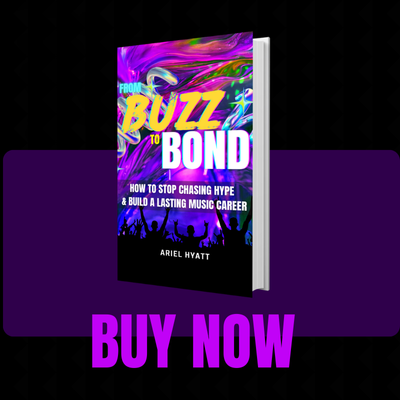
Hey, it’s Ariel. I’m really proud of my recent book, From Buzz to Bond, and of taking the inaugural cohort through the 7-Week Mastermind, which deeply inspired me to get back behind the mic.
Here’s why: The pattern I kept seeing is what pushed me over the edge.
Every artist I spoke to was investing small fortunes in Spotify playlisting, Meta ads, and TikTok strategy. And none of them were building real audiences.
That made me angry.
When I get angry, I think it all out on paper. That’s how my 7th book, From Buzz to Bond, was born. It’s less a book and more a mini-manifesto.
And this podcast series is the chance to go deeper and expand on those ideas.
So let’s get into it. Today we are breaking down buzz marketing vs bond marketing and why understanding this difference will change everything about your music career
What the Music Industry Told You Success Looks Like
Over the last several years, artists have been told — loudly, repeatedly, by platforms, by marketers, by the industry itself — that success is:
- Spotify streams
- TikTok credibility
- Viral moments
- YouTube plays
- Instagram reach
And I understand why artists believed it. These things are visible. They’re measurable. They feel like progress.
But here’s what nobody told you clearly enough:
Attention is not a career. Visibility is not income. And followers are not fans.
These things have become completely conflated — and it’s leaving independent artists exhausted, confused, and broke.
Meet John Dough
In From Buzz to Bond, I talk about a real client — actually, he’s an amalgam of many clients. I represent people who have real money and real talent and spend that money buying audiences.
I call him John Dough in the book.
Here’s his story: John bought over a million Spotify streams. Hundreds of thousands of YouTube views. He even paid a social media company to get followers and comment on everything he posted. Everything looked incredible from the outside.
And he still couldn’t put 50 people in a room outside his hometown. Honestly? He couldn’t put 10 people in a room.
Not a single booking agent would touch him — even though John was willing to pay them handsomely.
John Dough could not buy his way in.
And that’s the whole point. You can’t buy bonds. You have to build them.
What I Call Buzz Marketing (And Why It’s a Trap)
John’s story is not unique. It’s what happens when artists get caught in what I call Buzz Marketing — strategies designed to inflate numbers rather than build real relationships.
Buzz Marketing looks like:
- Paying for Spotify playlisting campaigns that generate streams from foreign countries
- Running Meta ads that drive more Spotify streams with no secondary strategy
- Chasing TikTok trends that have nothing to do with who you are as an artist
- Hiring growth services that promise real followers (they never are)
The moment your ad budget dries up, the streams drop.
The moment the algorithm shifts, your reach disappears. Because you never owned any of it. Zuckerberg owned it. Ek owned it. The platforms owned it.
You were renting attention, not building relationships.

The Buzz Marketing Danger Loops
Here’s what makes this so insidious: Buzz Marketing is addictive.
Every stream, every follower, every viral moment produces a dopamine hit. It feels like progress. So you do more of it. And the loop continues:
Chase trend. Get a hit. Dopamine. Chase again. Repeat.
Meanwhile, you’re building nothing. No real fans. No email list. No owned audience. No path to income.
I call these Buzz Marketing Danger Loops. And once you see them, you can’t unsee them.
I Was a True Believer (Confession Time)
Here’s where I have to be honest with you about my own history.
Back in the day, a label friend of mine who had moved to San Francisco and was deep in the ground-floor tech scene taught me how to use Twitter. It was early days, and I took to it like a fish to water.
I’m not kidding — there were a couple of years where I didn’t have a single thought that didn’t go on Twitter. I built 90,000 followers. I spoke at the 140 Conference and Social Media Week NYC.
I had my own keynote at the very first South by Southwest Interactive. I was ALL in.
And I was excited because I could genuinely see it working. I was meeting people, making real friends, promoting my artists. And joining actual conversations.
Then things changed.
With twelve years of hindsight, we all know what happened. The platforms got smarter and greedier. The cost was human mental health and a world that’s more divisive than ever. I don’t blame it all on social media, but I know it played a huge role, and I’m genuinely sad about that.
As the mom of a six-year-old, what makes me even sadder is knowing these machines are genuinely addictive. They were supposed to make us more connected. Instead, they make us feel lonelier.
Which is a very long way of saying: it has always been about connection. That’s how I’ve built my career. And that’s how every musician I know who has actually succeeded has done it — through real bonds, not borrowed attention.
We Had the Answer in 2008 (And Then We Forgot It)
Back in 2008, when I read Kevin Kelly’s 1,000 True Fans theory, the hair on the back of my neck stood up. My heart actually palpitated.
Someone had finally put into words what I had been instinctively learning while working at record labels and in concert promotion.
The math was simple and beautiful: 1,000 fans who each pay you $100 a year equals a sustainable living. That’s it. That’s the whole thing.
It’s all anyone talked about at music conferences for years.
And then we forgot about it.
Through every twist and pivot — gaming MySpace, moving to Facebook, watching that get decimated, getting hypnotized by Instagram, then Spotify, then TikTok.
Artists completely lost the thread. The focus shifted to being obsessed with big numbers hundreds of thousands, even millions.

You were nothing if you didn’t have a million of something.
Everyone got addicted to the numbers game. The snake oil salesmen showed up right on schedule — selling botted playlists, questionable video streams, and fake followers.
Here’s what breaks my heart: there was a genuine middle class of artists making real livings off the 1,000 True Fans model. Real careers. Real income. Real sustainability.
This middle class of musicians has largely disappeared.
Not because the theory stopped working. Because artists stopped applying it. They got distracted by the shiny thing. And the industry let them.
So if you’re reading this at midnight feeling like a failure because your Spotify numbers aren’t growing fast enough — I need you to hear this:
You are not failing. You have been chasing the wrong thing. And it is not your fault.
The Shift: From Buzz to Bond
Understanding buzz marketing vs bond marketing is the single most important mindset shift you can make as an independent artist
This is why I wrote From Buzz to Bond. And it’s why I’m back with this podcast.
Bond Marketing is the alternative. It’s built around one core idea: real fans, not rented attention.
Bond Marketing means:
- Building direct relationships with people who actually care about your music
- Owning your audience through email lists and direct communication
- Creating touchpoints that move casual listeners toward becoming paying supporters
- Building a fan community — what I call a Fan Sanctuary — where your most devoted people gather
- Developing repeatable systems that create momentum without burning you out
And here’s the math that actually matters: you don’t need millions of followers. You need 100, 200, 500, or 1,000 true fans — people who come back, who pay you, who show up. I’ve watched artists completely transform their careers with audiences that size.

The Bond Marketing Funnel
Over this entire podcast season, I’m walking through the system I’ve developed over 30 years, what I call the Bond Marketing Funnel. It has nine steps. Here’s the overview:
Step 1 — Brand Pillars, Fan Personas & Voice: Who you are, who you serve, and how you communicate. Nothing else works without this.
Step 2 — Social Media & Web Tuneup: Aligning your digital presence so attention doesn’t leak out through the cracks.
Step 3 — Capture Buckets: Systems that capture fan attention, email, SMS, and beyond, so you stop renting from platforms you don’t own.
Step 4 — Email List Building & Growth: Your most valuable asset. Unlike social media, you own it forever.
Step 5 — The 5 Touchpoints: Fans need to encounter you five or more times before they truly bond. Here’s how to create those moments intentionally.
Step 6 — Fan Sanctuary: A dedicated space for your most engaged fans, away from the algorithm, built around real community.
Step 7 — Repeatable Strategies: Systems that prevent burnout and create long-term momentum instead of release-cycle spikes.
Step 8 — Interactive Community: Where your fans start connecting with each other, not just with you.
Step 9 — Consistent Sales: The natural result of a bonded fanbase. People who want to support you and know how.
At the bottom, you have your Bonded Fanbase, where it all comes together into a self-sustaining career.
The first seven steps are what I teach in depth inside the Buzz to Bond 7-Week Mastermind. But more on that in a moment.

Your Three Fan Communities
One of the most important shifts in this framework is understanding that not all fans are the same. Every artist has three communities:
Ambient Fans — aware of you, may have heard your music, but don’t actively engage. These are your social media followers, people who saw an ad, or someone who found you on a playlist.
Engaged Fans — they like your posts, open some emails, and follow you on more than one platform. They’re paying attention. They just haven’t been invited deeper yet.
Superfans — your bonded true fans. They’ve connected with you across five or more touchpoints. They attend shows, buy merch, respond to your emails, and tell others about you. According to Luminate research, superfans spend up to 80% more on music monthly than average listeners.
The Bond Marketing Funnel is the system for moving people from Ambient to Engaged to Superfan. One intentional step at a time.
So Here’s What I Want You to Walk Away With
We’ve lost the plot. But it is not all over.
What the state of the world has taught us — if we’re paying attention — is that loneliness is a plague. It is pervasive. And community trumps everything.
That’s what Bond Marketing actually is. It’s not a marketing strategy. It’s community building. It’s connection. It’s what we are all starving for right now.
I want to be honest with you, though: Bond Marketing is not sexy. It is not a silver bullet. It takes work, moxie, grit, and real dedication.
Because what you’re asking people to do is stop the dopamine-hit scrolling on TikTok and actually come over and interact with you. Join you. That’s a big ask in 2026.
But every artist I know who has managed to build a financially viable career without millions of Spotify streams, without going viral, without buying their way in, has had to figure this out and relearn it. It’s a process. It’s not instant.
Those are the artists who feel most satisfied at the end of the day.
Not the ones with the biggest numbers. The ones with the realest bonds.
Less buzz. More bond.
Key Takeaways
- The music industry has defined success as streams, followers, and viral moments — none of which reliably translate to income
- Buzz Marketing creates the illusion of success while building no real foundation
- Bond Marketing is the alternative — building real fan relationships you actually own
- The Bond Marketing Funnel is a 9-step system for moving fans from casual listeners to bonded supporters
Frequently Asked Questions
What is the difference between buzz marketing and bond marketing for musicians?
Buzz marketing focuses on visibility metrics — streams, followers, viral moments, and paid reach — that create the appearance of success without building real fan relationships. Bond marketing is the opposite: it prioritizes direct connection with real fans through owned channels like email lists, fan communities, and consistent touchpoints. Buzz marketing rents attention from platforms. Bond marketing builds relationships you own.
What is the Bond Marketing Funnel?
The Bond Marketing Funnel is a 9-step framework developed by Ariel Hyatt of CyberPR Music for helping independent artists move from chasing metrics to building a bonded fanbase. The steps cover brand identity, digital presence, audience capture, email marketing, five key touchpoints, fan sanctuary creation, repeatable strategies, interactive community, consistent sales, and ultimately a bonded fanbase that sustains a long-term career.
What is a Buzz Marketing Danger Loop?
A Buzz Marketing Danger Loop is a cycle where artists repeatedly invest in visibility tactics — ads, playlisting campaigns, social media trends — that inflate numbers but never build real fans. The dopamine hit of rising metrics keeps artists in the loop, but the moment the ad budget stops, the numbers collapse. The loop is self-reinforcing, preventing artists from building anything sustainable.
What is Kevin Kelly’s 1,000 True Fans theory, and why does it matter for musicians?
Kevin Kelly’s 1,000 True Fans theory, published in 2008, argues that an artist needs only 1,000 dedicated fans who each spend $100 per year to earn a sustainable living. Music marketing expert Ariel Hyatt credits this theory as a foundational insight from her work at record labels and in concert promotion. She argues that the music industry abandoned this model in favor of chasing viral metrics — and that returning to it is the key to building a financially viable independent music career.
What is a Fan Sanctuary for musicians?
A Fan Sanctuary is a dedicated private community space where an artist’s most engaged fans gather — separate from public social media and away from algorithms. It could be a private Discord, a WhatsApp group, a Patreon community, or any closed ecosystem where fans opt in to deepen their connection with the artist and with each other. In Ariel Hyatt’s Bond Marketing Funnel, the Fan Sanctuary is Step 6 — where superfans are born and where the artist-fan relationship becomes truly self-sustaining.
How many real fans does a musician need to build a sustainable career?
Far fewer than most artists think. Based on Kevin Kelly’s 1,000 True Fans theory and Ariel Hyatt’s 30 years working with independent artists, having 100, 200, 500, or 1,000 genuinely bonded fans — people who buy tickets, purchase music and merch, and show up consistently — can fundamentally transform an artist’s career. The focus should always be on depth of connection, not breadth of reach.
Listen to Episode 1 of the CyberPR Music Podcast
Where to Go Next
If this hit something true for you — if you’ve been doing everything you were told and still feel like something is broken — I want you to go deeper.
And if you’re ready to build this with a group, the Buzz to Bond 7-Week Mastermind launches July 13, 2026. Small group. Live. We build your entire fan system together step by step over seven weeks.
[ + ] Click Here to Read the Full Episode Transcript
Cyber PR Music Podcast Season 3 Episode 1: The Music Industry Has Been Lying to You About Success
ARIEL HYATT: I’m Ariel Hyatt, and this is the Cyber PR Music Podcast, Dispatches for the New Music Business. This show is all about helping independent artists stop chasing buzz and start building bonds. Real fan relationships that lead to income and long-term fulfilling careers.
Hey, it’s Ariel, and welcome to a brand new season of the CyberPR Music Podcast. This one is a big one because this year marks 30 years since I got into helping musicians, and I founded Ariel Publicity 30 years ago to the month. The second reason why I am really fired up to create a new season is that I have a new book out, and it’s called From Buzz to Bond.
The last few years, I’ve seen an alarming pattern that’s been going on with independent and major musicians. And that is, we’ve taken our eye off the prize of connection, communication, and monetization through direct to fan. And a lot of the light started getting shown on what I call buzz marketing—TikTok, Spotify plays, getting as many social media followers as possible.
These are not the things that are going to lead to a successful career in music. And in this next season, I’m going to be unpacking why. So, in my thinking about everything that’s been going on in the industry these days, I do happen to hear a battle cry from a lot of artists. And that is: why am I not making money? Artists are more exhausted than ever before.
And that has a lot to do with the waterfalling that has to consistently happen, and the fact that I think artists are on a bit of a hamster wheel. Every four to six weeks, you have to keep showing up, you have to keep releasing, and you have to keep putting your art across platforms, which can wear you down really, really quickly. So, artists these days are expected to consistently create music, post it every four to six weeks, market endlessly on social media, rinse and repeat.
And the problem with that is it stops the bigger picture from happening. And when I say bigger picture, I mean: how are you monetizing? How are you putting money in your pocket? How are you really thinking about how to add true fans to your fan base and stop renting from Zuckerberg and Ek? These are the things that were keeping me up at night. And that’s what prompted me to write From Buzz to Bond.
So back in 2008, when I wrote Music Success in Nine Weeks, I was thrilled and excited about social media. I was living and dying on Twitter, and I literally met hundreds of friends. I would connect with people at the 140 conference, and I circled the globe literally begging musicians to get onto that platform. Now, with 12 years of hindsight, we’ve noticed something. Social media does not connect us in the way that it initially did.
Social media doesn’t always make us feel great about ourselves. In fact, there are numerous studies that show that social media is making us feel more lonely, and comparing ourselves to other people is what it forces us to do. And that’s not healthy, especially not for a creative mind. So as I’ve been rethinking about what social media did for me back in the day when I was so excited about it, I came to a conclusion. I was so excited about it because social media helped us to connect to one another. But there’s been a major shift. The social media companies got smart and they got greedy. And instead of connection, they started emphasizing addiction.
And so now, instead of feeling like you’re using this tool to actually maybe connect with humans, you’re using it now like a slot machine with dopamine hits as the payoff. And that is not healthy and it’s not good for artists.
When you’re thinking about your music career now, I want you to have a little bit of a reset. Instead of how many numbers and streams and how many follows and how many TikTok moments can you have? Ask yourself: How do I want to feel? That’s the guiding light. The next question you want to ask yourself is: What kind of career do I want? Musicians tell me all the time, I want to quit my day job. I’m not happy in my day job. I just want to make music full-time.
That means you’re going to have to consider being a multi-hyphenate artist, unless of course, you can somehow magically generate a billion streams a year, which very few artists can actually do. And that means you’re going to have to think about how else are you monetizing your art and your audience? It’s those practical thinking steps that got me to write From Buzz to Bond. And I realized if you could have just 100, 200, 500, or a thousand more fans in your immediate circle, your lives would probably change.
Many artists coming into the music industry and releasing music start with things like: I just want as many people as possible to hear my music. I just want to get on Spotify playlist and get my numbers up. I just want to have a viral moment on TikTok. I just want to catch as many followers on Instagram as possible. All of those things don’t make a true fan base.
And that’s what I started thinking through when I started writing From Buzz to Bond. Buzz marketing danger loops are what happen when you consistently think and want more and more and more. The Bond marketing funnel is my solution on how to stop the buzz marketing dopamine hits and start building a true audience that really connects with you.
So instead of starting with what do I post, how do I grow, and how many hits can I have? You want to ask yourself: What’s the feeling that I want? What kind of career do I see myself having? And how can I connect more deeply with others? In order to do this, we need to talk about real math. If you know that a Spotify play is 0.003 cents, that’s a heck of a lot of plays in order to make anywhere near a sustainable income. However, when you start bonding with people and making sure that you have offers that are worth far more than less than a penny, the whole entire equation begins to shift. And that’s what I want to walk you through throughout this next series. You cannot monetize without fans.
Quick thing: if you’re trying to figure out how to actually make money from your music, I’ve got a free training for you. In it, I break down how to move from chasing streams and followers to building real fans who actually support you. You can watch it right now at the link in bio or at cyberprmusic.com. Click on the free webinar. Go check it out. It’ll connect the dots.
Fans are customers. Customers are people who give you money. There’s something coming towards us too that we need to talk about and consider, and that is AI. AI can be extremely useful when it comes to helping you save time, energy and effort because it’s wonderful as a marketing assistant. I caution you and encourage you to use artificial intelligence and large language models to help you slog through the pain points like social media captioning, press releases, not writing, but editing, and using it to help you tweak your brand. AI is not the problem. The problem is what you’ve been taught in recent years: that followers and streams equal success.
What I have seen time and time again, working at my agency and holding hands with artists to get them to transform their careers, is that more fans equal success. And not just any fans—fans that are here to support you, help you, and pay you along the way. And it’s getting your arms around those fans that will be the thing that transforms your career. Platforms are rented. You don’t own anything that you post on them. Attention does not equal support, and visibility does not equal income.
Somehow, along this weird journey of the last few years, all of this has become conflated, and artists have become misguided and confused. This is where you have to begin to think through the shift. It’s not about more content. It’s not about greater visibility on platforms like Spotify. It’s about real people, real fans, true relationships, and how you’re going to grow and foster those. People who come back, people who listen and pay attention, and pay you for your art. That’s the formula.
This is where collaboration matters, creating a scene matters, building something that you’re the center of, where people are there to support you. I have seen hundreds of artists do this successfully, and all it takes is a mindset shift and taking your eyes off the dopamine hits of Spotify, TikTok, and social numbers, and putting that time and energy and effort towards real fandom. This is what I call from buzz to bond. And that’s what the whole book is about. This is the shift from attention to connection to actual income.
Over the next several episodes of the podcast, I’m going to be bringing in some of my favorite friends and colleagues in the business and the entire Cyber PR team. We’re going to be showing you examples of who’s doing it and how, as well as walking you through the nine steps of the bond marketing funnel. If you feel like you’ve been doing everything and not getting paid, it’s not you. You’ve been focusing on the wrong things because the music industry has actually been pushing the wrong things for the last several years. It is my intention to bring you back to what actually matters: connection with fans, real people.
Creating scenes and people who love and support you monetarily with what you’re doing. Collaboration matters, and building a scene is the center of it. And in the end, that is what is actually going to make you money. So I look forward to unpacking the Buzz to Bond system and the Bond marketing funnel over the next several episodes. This is not about more followers or more streams. It’s about real fans who actually support you.
If you want to go deeper, check out the free Buzz to Bond webinar in the show notes, or visit CyberPRMusic.com for over 300 articles and strategies for today’s music business. Less buzz, more bond.
Subscribe for more!
Back to The Blog